The US/China trade conflict escalated this week when the US announced tariffs on $200bn of Chinese goods. Policymaker intent to stabilize CNY sentiment however meant that USDCNH remained more or less unmoved by this development.
Moreover, commercial banks in Hong Kong raised the prime rate (the best lending rate) by about 12.5bps, the first time since 2006. The PBoC appears to be lagging behind as they still want to maintain an accommodative monetary policy stance to support the growth. As a result, the CNY is still under depreciation pressure, not only against the USD, but also the Asian peers.
EURCNH risk-reversals are a better-value alternative to USDCNH as a hedge against an intensification of trade tensions. As an underlying, EURCNH is a credible stand-in for the CNY TWI given the Euro’s 16% direct weight in the CFETS basket as well as its positive correlation to other basket constituents. It also carries appreciation potential in coming weeks now that the broad dollar has started to soften, which in the past has proven to be market environments in which CNY has often lagged the strength in trade partner currencies.
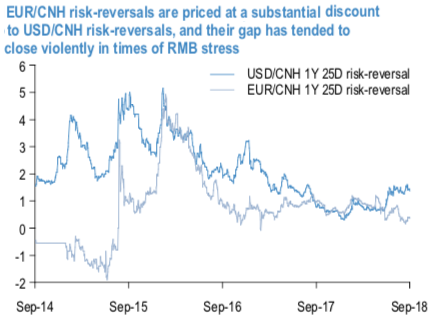
Needless to specify, there is also greater incentive to repeat the pattern this time around in light of the trade backdrop. How useful is EURCNH as a RMB weakness play? Using the sell-off in the currency since the first batch of tariffs in June as a guide, EURCNH rose 6% alongside the 9% trough-to- peak rally in USDCNH, so a beta of 0.7x. 1Y 25D EURCNH risk-reversals however priced at a paltry 0.35, much narrower than corresponding USDCNH riskies around 1.35 (refer above chart); per the graphic, this is not a large gap by historical standards, but it is also true that these gaps have tended to close rather violently in times of RMB stress. We suspect that much of the non-responsiveness of EURCNH skews this year owes to the above-average bid for EUR puts in general, reflecting the option market’s nervousness around the Italian budget. Such skittishness explains why other EUR/Asia risk-reversals are also priced near 5-yr tights (e.g. EURKRW). Courtesy: JPM
Currency Strength Index: FxWirePro's hourly CNY is flashing 20 (mildly bullish), hourly EUR spot index is -93 (bearish), hourly USD spot index is inching towards 95 levels (which is bullish), while articulating at (14:02 GMT).
For more details on the index, please refer below weblink:http://www.fxwirepro.com/currencyindex