


 Bitcoin Price Falls Below $83K as Liquidations Hit $697M
  Solana Price Drops 3% Despite Samsung USDC Partnership
  Urban studies: Doing research when every city is different
  Dogecoin Liquidations Surge as DOGE Bulls Face Heavy Losses
  Goldman Predicts 50% Odds of 10% U.S. Tariff on Copper by Q1 Close
  Jameson Lopp Downplays AI Threat to Bitcoin Cryptography
  U.S. Treasury Yields Expected to Decline Amid Cooling Economic Pressures
  Moldova Criticizes Russia Amid Transdniestria Energy Crisis
  US Futures Rise as Investors Eye Earnings, Inflation Data, and Wildfire Impacts
  Global Markets React to Strong U.S. Jobs Data and Rising Yields
  XRP Whale Activity Drops 27% in Eight Days Amid Market Sell-Off
  Oil Prices Dip Slightly Amid Focus on Russian Sanctions and U.S. Inflation Data
  2025 Market Outlook: Key January Events to Watch
  China's Refining Industry Faces Major Shakeup Amid Challenges
  Gold Prices Fall Amid Rate Jitters; Copper Steady as China Stimulus Eyed
  US Gas Market Poised for Supercycle: Bernstein Analysts


 Add as a preferred source on Google
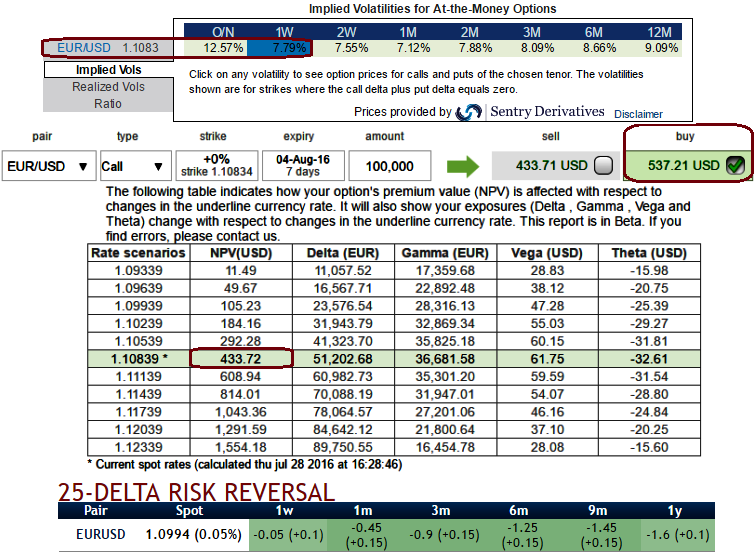
Please be noted that the ATM IVs of this EURUSD are creeping up at 7.79% and 7.12% for 1w and 1m tenors respectively. Whereas the ATM premiums are trading 24% more than NPV, the disparity between IVs and premiums are majorly due to probably yesterday’s Fed’s monetary policy decision that has been unchanged.
As a result, EUR call premiums overrated which is mismatching with the ATM IVs, while 25-delta risk reversals flash reduced bearish hedging sentiments in all expiries. The same cost does not mean the same risk profile.
There is no free lunch in financial markets: the cheaper an option strategy, the riskier it is. However, the statement is purely quantitative while appreciation of risk is to a large extent a qualitative issue.
We consider a risk reversal (RR) strategy long OTM call and short OTM put at a small cost. The strategy has unlimited topside gain and downside loss.
Alternatively, one can buy the OTM call only, but with a topside knock-out barrier (an RKO call) with a level set such that the exotic option has exactly the same cost as the RR strategy initially considered.
This time, the risk is limited to the premium, but at some point, the gains can definitely disappear. While they have the same cost, these two risk profiles can hardly be more different for an investor.
The cost of an optional strategy is merely the average of all its possible payoffs, weighted by the probabilities that the market attaches to the corresponding scenarios. There is an infinite number of ways to obtain a given expected gain, and therefore an infinite number of non-equivalent strategies with the same cost.
So, how do we meaningfully discriminate strategies if cost is not a reliable indicator?
Well, we can distinguish the strategies by adjusting the notional instead of lowering the premium:
We first need to determine the immediate consequence of dismissing cost as the main decisional input, as the depth of investors’ pockets is not unlimited. The objective is to obtain the most appropriate risk reward by dollar spent, not minimise the premium in percentage or pips.
Once the optimal strategy is identified, the notional should be adjusted according to the budget constraint and the premium, not the other way around. A notional of $10m should be used if the strategy costs 1%, or $5m if the premium is 2%.







