


 XRP Holds Steady at $1.39 as Crypto Market Faces Heavy Liquidations
  Jameson Lopp Downplays AI Threat to Bitcoin Cryptography
  DWF Labs Sues BitGo for $114 Million Over Alleged Token Sales Breach
  Morgan Stanley Raises Coinbase Stock Price Target to $258 Ahead of Earnings
  XRP Ledger Activates New Security Feature for Banks and Stablecoins
  Stellar Overtakes Ethereum in RWA Fund Inflows as XRP Leads Commodities
  Zcash Plans Quantum-Resistant Security Upgrade for January
  Chainlink Price Drops 3% Despite New CCIP Vault Launch
  Solana Targets 200ms Block Time in Major Network Upgrade
  Bitcoin Rebounds to $82K as Trump Eases Iran War Fears
  Ledger Investigates Alleged $86 Million Crypto Wallet Theft


 Add as a preferred source on Google
By the end of 2016, we expect USDCNY to be testing 7.0 due to a mix of cyclical USD strength as well as domestic factors. FX intervention cannot continue indefinitely. Widening GDP growth, inflation, and interest rate differentials also argue for a higher USDCNY. By the end of 2016, we expect the benchmark 1-year lending rate to be at 4.10% and the RRR (for major banks) to be at 15.5%.
Our central scenario of USDCNY reaching 6.90 remains unchanged since August of last year. We assign an 80% probability to this outcome and a 20% probability to the risk scenario of 7.50.
We continue to foresee USDCNY peaking at 6.90 over the next quarter. Capital outflows continue to exceed the current account surplus, which requires on-going depletion of FX reserves.
Capital outflows and intervention slowed quite dramatically in March/April compared to prior months but appear to have picked up recently.
The PBoC has ample, but not unlimited, reserves to defend the currency, and ultimately we believe that they will succumb to market forces and allow the CNY to depreciate further in a gradual and controlled manner.
The USDCNY rate remains correlated to the broad movements in the USD, so additional dollar strength (our G10 FX team expects DXY to rise by 5%) will exert additional downward pressure on the renminbi. Given the PBoC’s preference for a stable-to-weaker trade-weighted exchange rate, if the dollar begins to weaken there will be limited gains in the RMB.
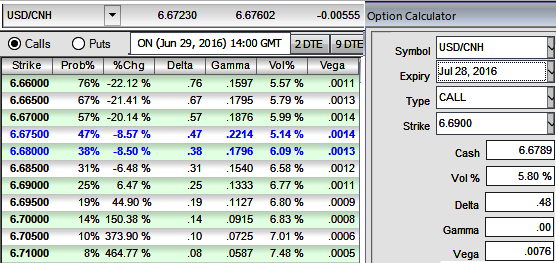
In the meantime, following USD softness, CNY has weakened somewhat against the basket of currencies. Hence, it is recommended to buy either 3M USD/CNY forwards of march expiries or deploy debit call spreads eyeing on above mentioned forecasts of USDCNY.
We understand that there is little-implied volatility in the OTM strikes which is why it is advisable to choose longs in ITM strikes in this call spreads.







