


 Solana Alpenglow Upgrade Set for October 21: What It Means for SOL
  Gold vs Bitcoin: Investors Eye Inflation Hedge as Crypto Adoption Grows
  UBS Projects Mixed Market Outlook for 2025 Amid Trump Policy Uncertainty
  China’s Growth Faces Structural Challenges Amid Doubts Over Data
  Stock Futures Dip as Investors Await Key Payrolls Data
  Bitcoin Price Drops as US Dollar Hits 18-Month High
  Morgan Stanley Predicts $10 Trillion RWA Market by 2030
  AI Crypto Payments Surge to 138 Million Transactions on Base
  Moldova Criticizes Russia Amid Transdniestria Energy Crisis
  Gold Prices Slide as Rate Cut Prospects Diminish; Copper Gains on China Stimulus Hopes
  UNCX Network Hack Drains $86K From Ethereum Token Pool
  S&P 500 Relies on Tech for Growth in Q4 2024, Says Barclays
  2025 Market Outlook: Key January Events to Watch
  European Stocks Rally on Chinese Growth and Mining Merger Speculation
  XRP Price Drops 3% Despite Ripple-Backed Evernorth Nasdaq Debut
  Bank of America Posts Strong Q4 2024 Results, Shares Rise
  Pi Network Price Eyes $0.10 Ahead of Protocol 28 Upgrade


 Add as a preferred source on Google
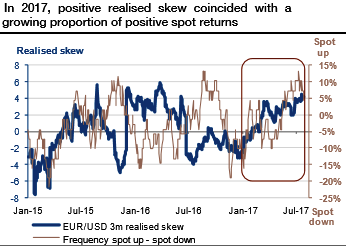
EURUSD skews seem to have turned towards calls, and that’s only the beginning. The option skew reflects the relative appetite for calls and puts, which only partly reflects pure directional expectations. The skew is primarily about volatility expectations conditional on a scenario on the spot.
Market makers actually trade the skew as per their perception of topside compared with downside volatility. To this end, we computed a realized skew that can be used like realized volatility. If we zoom in on the recent period, the EURUSD daily realized skew switched to positive territory in early March.
We daringly forecast in early June that the EURUSD skew might turn in favor of calls after a period of negative skew since autumn 2009. This is happening and is possibly the beginning of a new volatility regime.
The Societe Generale metric for realized skew shows that it has become positive since EURUSD broke 1.08 (right after the first round of the French presidential election) and that the positive realized skew coincided with a growing proportion of positive spot returns.
An overshoot to 1.20 is still in sight for this summer; risk reversals should exhibit more bullishness.
The weak euro range of 2015-17 corresponded to the bulk of ECB asset purchasing, and, more universally, the period of negative skew since 2009 corresponded to global central bank accommodation. The ECB still has to clarify how the QE process will reverse, and the Fed must outline when balance sheet normalization will start. With these major communication steps still upcoming, the full bullish impact on the EURUSD skew has probably yet to be seen.
Hence, we advocate initiating longs in EURUSD 1y corridor volatility swap, range 1.17-1.20 Indicative offer: 6.9 (vs 8.1 for the standard volatility swap).
This product is similar to a standard volatility swap, except that volatility is taken into account only when the spot trades within a pre-defined range (the ‘corridor’). 1.17 is above the upper bound of the previous range, and 1.20 is the next psychological resistance.







