


 Fed Rate Hike Threatens Housing as U.S. Growth Leans on AI, Citi Says
  Evernorth XRPN Nasdaq Listing Delayed to October 12
  Fed May Resume Rate Hikes: BofA Analysts Outline Key Scenarios
  Fed’s Hammack Says Bond Yield Surge Is Not Driven by Inflation Fears
  RBI Raises Repo Rate to 5.50% in Hawkish Shift on Inflation Risks
  Solana User Growth Jumps 33%, Outpacing Ethereum and Chainlink
  Kalshi Withdraws PEPE Perpetual Futures Filing
  US Futures Rise as Investors Eye Earnings, Inflation Data, and Wildfire Impacts
  RBI Uses $10 Billion Currency Swaps to Drain Excess Rupee Liquidity
  Trump Demands Powell Resign Over Fed Renovation Cost Overruns
  U.S. Treasury Yields Expected to Decline Amid Cooling Economic Pressures
  Trump’s "Shock and Awe" Agenda: Executive Orders from Day One
  Ethereum Price Drops Below $2,600 as Long Liquidations Hit 4-Month High
  Robinhood Buys $25 Million in Bitcoin for Corporate Treasury


 Add as a preferred source on Google
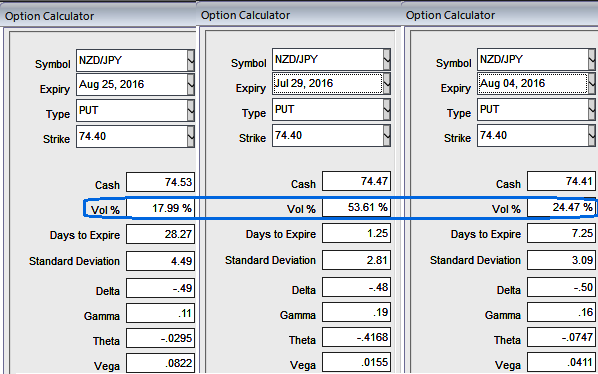
The implied volatilities of ATM contracts for near month expiries of this the pair are spiking in sky-rocketed pace. Here are the evidences:
ATM IVs of this pair is trending higher at around 53.61%, 17.99% and 24.47% for 1D, 1M and 1W expiries respectively which is the highest among G20 currency space. While current IVs of ATM contracts are at highest levels which seem quite absurd but likely to perceive hover around at an average 18% in the long run that would divulge pair’s gain contemplating risk reversal arrangements.
We give the absolute credits of the rising IVs to monetary policy season, as Yen remains fairly well bid against Kiwi despite the BoJ’s upbeat assessment of the Japan economy and deflationary pressures from decades together.
This week is a busy one for Japan data watchers with many June releases including CPI, housing starts, and FX markets digesting the better than forecasted trade balance data, while the key focus should be on Friday’s BoJ policy meeting.
With a clear slowing in the inflation trend and inflation expectations among both corporates and households, and Brexit, we find it hard to imagine whether the BoJ would ease this week or not, given its frequent statement “the central bank would observe risks to economic activity and prices, and take easing measures in terms of three dimensions—quantity, quality, and the interest rate.
The economy has struggled with deflation for two decades. Even after the BOJ's massive qualitative and quantitative easing (QQE) program and venture into negative interest rates territory, the Asian economy hasn't been able to boost domestic consumption and shake off deflation.
Indeed, according to the Japan Center of Economic Research, 86% of 42 economists surveyed between June 27 and July 4 expect policy easing next week. No action by the BoJ would erode its credibility on achieving the inflation target and tighten monetary conditions through JPY appreciation.
Whereas an OCR cut by RBNZ is all on the table but seems fully priced in for next month as the major contributor of Kiwis growth the GDT price index has shown a remarkable improvement has sent an earlier confirmation of easing bias, but FX markets remain reluctant to get short in Kiwi dollar.
NZDJPY’s rising implied volatility could be used as follows in option strategies:
Trading implied volatility directionally (vega)
Capturing the volatility risk premium in trading the gamma (dynamic delta-hedging)
Trading the volatility market (smile and term structure dynamics) non-directionally.







