


 Oil Prices Rise as Hormuz Attacks Fuel Supply Fears
  Mike Rogers Calls for End to US-Canada Tariff War
  Strategy’s STRC Nears $100, Raising Prospects for Major Bitcoin Buys
  Evernorth XRPN Nasdaq Listing Delayed to October 12
  RBI Uses $10 Billion Currency Swaps to Drain Excess Rupee Liquidity
  BOJ Raises Interest Rate to 31-Year High as Yen Weakens
  US Dollar Hits 18-Month High as Fed Signals More Rate Hikes
  US Stock Futures Flat as Fed Minutes, Earnings Loom
  Fed Unveils Stablecoin Rules Under GENIUS Act
  Oil Prices Rise as Hormuz Risks Offset IEA Stock Release
  Zcash Mining Profits Surge as Liquidity Risks Grow
  Fed Rate Hike Threatens Housing as U.S. Growth Leans on AI, Citi Says
  US-Led Coalition Targets Global Factory Overcapacity
  Bitcoin Price Falls Below $83K as Liquidations Hit $697M
  Samsung, SK Hynix Shares Fall Ahead of Q3 Earnings


 Add as a preferred source on Google
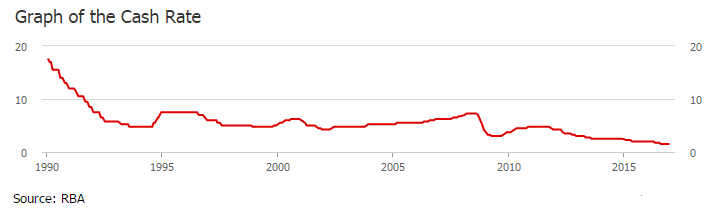
The easier monetary policy has helped to bolster country’s demand, as the Reserve Bank of Australia (RBA) reacted to sub-target inflation by cutting the official rate by 50 basis points this year to 1.50 percent.
Additionally, the RBA’s policy stance in 2017 will completely depend on the developments in consumer inflation and in the event that the Australian dollar appreciates. The RBA's first monetary policy meeting for 2017 is scheduled to be held on Tuesday, February 7.
We at FxWirePro, expect that the RBA's OCR will slide to 1 percent before end-2017 if consumer inflation fails to reach the CB's target range. However, the central bank is also likely to remain on hold then as the recovery in global energy prices, consistently lower unemployment and recent indications of solid economic growth do not motivate a further interest rate cut until the first half of 2017, unless there is a strong appreciation in the Australian dollar in the near term.
Moreover, Australia's GDP during the third-quarter of this year contracted, at the biggest pace since the global financial crisis in 2008-09 and also in sharp contrast to what markets had initially anticipated. The major drag came from mining and investment, along with weakness in consumer spending as well.
The country's third-quarter GDP contracted -0.5 percent q/q, down from +0.6 percent in the previous quarter, against market expectations of a +0.3 percent q/q rise. However, on an annual basis, it came in at +1.8 percent y/y (consensus was for +2.5 percent y/y), falling sharply from previous 3.3 percent y/y.
Meanwhile, the RBA, also, believes that the weak momentum will be short-lived, as is evident from the December monetary policy meeting. According to the central bank's half-yearly forecasts, the economy is expected to register an annual growth of around 3 percent in December quarter. Lastly, we expect that the RBA will be forced to lower rate if economic conditions fail to improve in 2017.
Meanwhile, AUD/USD has appreciated during the first quarter of this year, while making a correction through the rest of the year, depreciating and also remaining volatile. The currency pair is now trading at 0.7206, up 0.40 percent, while at 5:00GMT, the FxWirePro's Hourly AUD Strength Index remained neutral at 60.20 (a reading above +75 indicates a bullish trend, while that below -75 a bearish trend). For more details, visit http://www.fxwirepro.com/currencyindex







