


 BlackRock’s Rick Rieder Favors Bonds Over Stocks as Treasury Yields Surge
  Zcash Privacy Demand Rises as AI Exposes Bitcoin Transactions
  RBI Raises Repo Rate to 5.50% in Hawkish Shift on Inflation Risks
  Robinhood Buys $25 Million in Bitcoin for Corporate Treasury
  Cardano Price Eyes $0.30 as ADA Whale Activity Surges
  UBS Predicts Potential Fed Rate Cut Amid Strong US Economic Data
  US Futures Rise as Investors Eye Earnings, Inflation Data, and Wildfire Impacts
  Ethereum Price Drops Below $2,600 as Long Liquidations Hit 4-Month High
  DogecoinVM Makes DOGE Transactions 300x Faster
  JPMorgan CEO Jamie Dimon Warns Mythos AI Raises Cyber Risk Tenfold
  Kazakhstan and Tether Explore Tenge Stablecoin and RWA Tokenization
  China Shuts 670 Banks as Bitcoin Eyes Financial Risks
  Indonesia Surprises Markets with Interest Rate Cut Amid Currency Pressure
  Gold Prices Fall Amid Rate Jitters; Copper Steady as China Stimulus Eyed
  U.S. Stocks vs. Bonds: Are Diverging Valuations Signaling a Shift?


 Add as a preferred source on Google
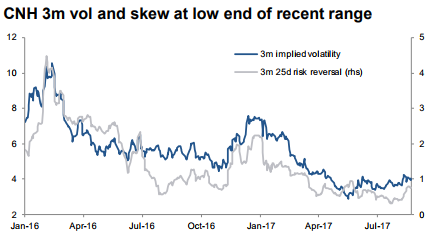
Why doesn’t PBoC fix a neutral USDCNY rate? It is comprehensible that the PBoC intended to guide its currency stronger when everyone expected to see a rapid CNY depreciation, which was the idea behind the “counter-cyclical factor”. However, although the market has become much more neutral on its yuan outlook now, the USDCNY fixing still tends to surprise on the downside, which happened this morning again.
Hedging the “red line”: Logical hedge to North Korea is long USDKRW or long JPYKRW, but won options are pricey. China is unlikely to be safe haven asset.
Hedging extended price action: CNH would weaken alongside a correction in the EUR (positioning elevated, expensive vs real rate differentials).
Hedging a growth slowdown: An earlier or larger Chinese growth slowdown could alter current bullish positioning.
Vol parameters: Current parameters (skew and convexity) are generally conducive to owning volatility and positioning for the possibility that the recent strength is partially reversed.
Hence, we advocate buying USDCNH 3m call strike 6.83. Entry level (date): 0.41%, spot ref: 6.69 (May 18 2017) Maximum loss limited to premium paid.
USDCNH and implied vol is marginally below our entry level; use as a hedge against North Korea risks, EUR correction, and for portfolios that are short dollars and long carry such as our own.
Risks & what to watch for:
USD dynamics and leadership changes: Capital outflows are minimal, so CNH might need to adjust alongside a broader dollar move. Also, there is a risk that the authorities promote FX strength ahead of the leadership changes in late October.







