


 Bank of America Predicts Yen Rebound as USD/JPY Faces Risks
  US Dollar Rises for Fourth Week as Fed Rate Hike Bets Grow
  Asian Currencies Steady as Dollar Eyes Fourth Weekly Gain
  Gold Prices Fall Amid Rate Jitters; Copper Steady as China Stimulus Eyed
  Gold Prices Fall as Fed Signals Another Rate Hike
  Trump Calls for Zelenskyy Replacement Amid Russian Diesel Deal
  Gold Prices Rise as Hormuz Tensions Fuel Inflation Risks
  US Dollar Hits 18-Month High as Fed Signals More Rate Hikes
  Mike Rogers Calls for End to US-Canada Tariff War
  Bangladesh GDP Growth Accelerates to 4.6% on Industrial Rebound
  Iran Refuses to Halt Uranium Enrichment Amid US Nuclear Demands
  US Treasury Yields Ease After Strong 10-Year Auction as Global Bonds Struggle


 Add as a preferred source on Google
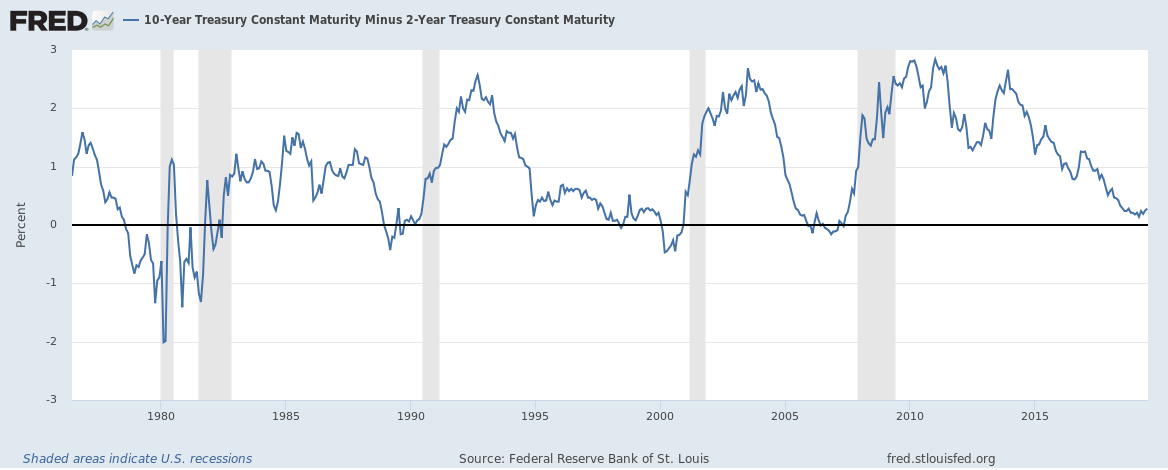
There are many indicators like PMI reports, jobs reports, inflation, industrial output, business sales, etc. that we take a look into in determining whether the US economy is slowing down and heading for a recession but there is one indicator, which we are not losing sight of, which is widely considered as the most reliable predictor of a recession and that is the yield difference between a 10-year U.S. Treasury bonds and a 2-year treasury bonds.
This chart from the St. Louis Fed’s economic dashboard shows that the spread has correctly predicted the last five recession. Every time before the US economy suffered a recession, the spread dipped below zero. Recession follows within 24 months, whenever spread dips below zero.
The spread has been steadily declining since 2014, as the U.S. Federal Reserve raised interest rates from 0.25 percent to 2.25 percent, pushing short-term rates higher, while lower inflation expectation pushed long-term yields lower.
However, there has recently been a shift upwards in this indicator, as the U.S. Federal Reserve signaled rate cuts. The upward shift further fades the possibility of an immediate recession.
Moreover, the U.S. GDP growth also suggests that the recession is still a far-fetched idea. Despite the recent slowdown, the U.S. economy grew by 3.1 percent y/y in the first quarter of 2019.







