
In response to President Trump announcement that his administration would impose 25 percent tariffs on all Steel imports and 10 percent tariffs on Aluminum imports, the European Union has announced that if the United States moves ahead with such tariffs it would impose counter-tariffs on U.S. goods.
As always, President Trump has remained defiant and asserted that trade wars are good and easy to win since the United States runs a very large trade deficit in goods, to the tune of $800 billion. However, what he forgot to mention is that any war is usually long and can do significant damage to all parties before a victory can be achieved.
Data strongly suggest that while U.S. China trade war is totally different ballgame since the United States exports around $130.4 billion dollar worth of goods while imports $506 billion, a trade war with the EU would significantly damage both before any victory can be achieved.
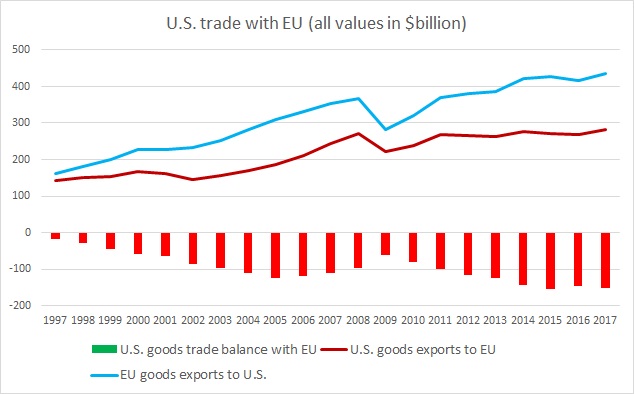
The chart shows, U.S. trade deficit with the EU reached a record high of $151.4 billion in 2017, which suggests that Trump’s trade war might benefit the United States if deficit reduction can be achieved. However, U.S. exports to the EU is not insignificant. While the U.S. imported $434.9 billion dollars’ worth of goods in 2017, it exported $283.5 billion dollars’ worth of goods, which is more than double than what it exported to China.
An all-out trade war with EU would hurt both the economies significantly before the United States can achieve a victory.

