


 Best Gold Stocks to Buy Now: AABB, GOLD, GDX
  FxWirePro: Daily Commodity Tracker - 21st March, 2022


 Add as a preferred source on Google
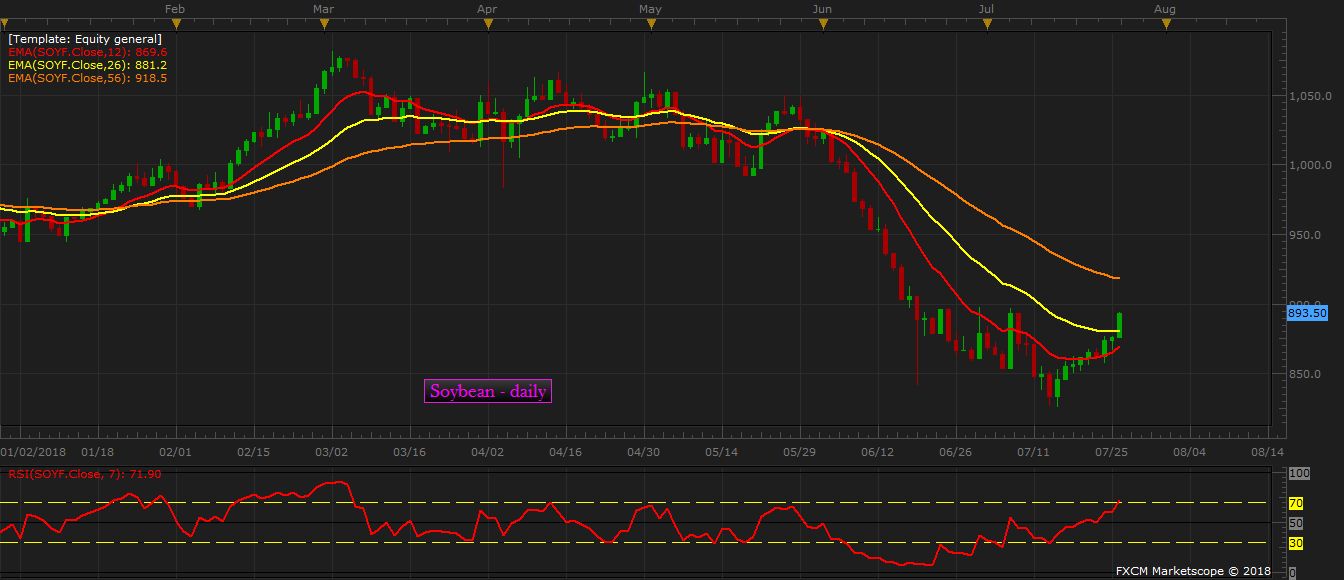
Yesterday, after meeting with European Commission President Jean Claude Juncker, President Trump announced that the United States has reached an agreement with the European Union in principle, which would formally begin the negotiation process with an aim to work together toward zero tariffs, zero non-tariff barriers, and zero subsidies on non-auto industrial goods. Barriers would be reduced and trade is services, chemicals, pharmaceuticals, and agricultural products will increase. The EU would immediately increase imports of U.S. soybeans, along with an increase in imports of U.S. liquefied natural gas (LNG). Both parties would resolve the steel and aluminum tariffs as well as other retaliatory measures as part of the negotiation process.
While the European Union’s agreement to buy soybeans from the United States is a good news but definitely not a great one. Simply because, when it comes to soybeans, the EU’s appetite is not a voracious as China’s, which in response to President Trump’s tariffs on Chinese goods have imposed its own tariffs on Soybeans.
Here are some facts to enlighten the argument:
- The United States is the second biggest exporter of soybeans after Brazil and its global export share is 37.2 percent.
- On the other hand, China is the largest importer of soybeans, with a global market share of more than 33 percent. In 2017, China imported $39.5 billion worth of soybeans.
- Now, we come to EU, where the top three biggest importers are Spain, Germany, and the Netherlands. These three countries together imported $3.7 billion worth of soybeans in 2017, which is minuscule compared to that of China.
However, the market is currently rising on the outcome and the price of Soybean is up more than 3 percent in the U.S. and currently trading 893 cents per bushel.







