


 David Schwartz to Reveal XRP Ledger Future at Ripple Swell 2026
  U.S. Government Moves Over $100M in Bitcoin and BNB
  Solana Price Drops 3% Despite Samsung USDC Partnership
  Cardano Hits Record 436 TPS as Network Scaling Advances
  Chainlink Price Drops 3% Despite New CCIP Vault Launch
  JPMorgan CEO Jamie Dimon Warns Mythos AI Raises Cyber Risk Tenfold
  Jameson Lopp Downplays AI Threat to Bitcoin Cryptography
  Evernorth XRPN Nasdaq Listing Delayed to October 12
  Kazakhstan and Tether Explore Tenge Stablecoin and RWA Tokenization
  Ethereum Price Drops Below $2,600 as Long Liquidations Hit 4-Month High
  US Government Moves $1 Billion in Bitcoin Amid Sale Speculation
  DogecoinVM Makes DOGE Transactions 300x Faster
  XRP Whale Activity Drops 27% in Eight Days Amid Market Sell-Off


 Add as a preferred source on Google
The U.S. Federal Reserve's rate hike showed confidence in the world's largest economy, but "spillover" effects from the hike could lead to tighter credit conditions and higher debt servicing costs for emerging markets. Companies that have loaded up on dollar-denominated debt are at particular risk, with increased chances of defaults. The IMF has calculated that emerging market companies have "over-borrowed" by $3 trillion in the last decade, reflecting a quadrupling of private sector debt between 2004 and 2014.
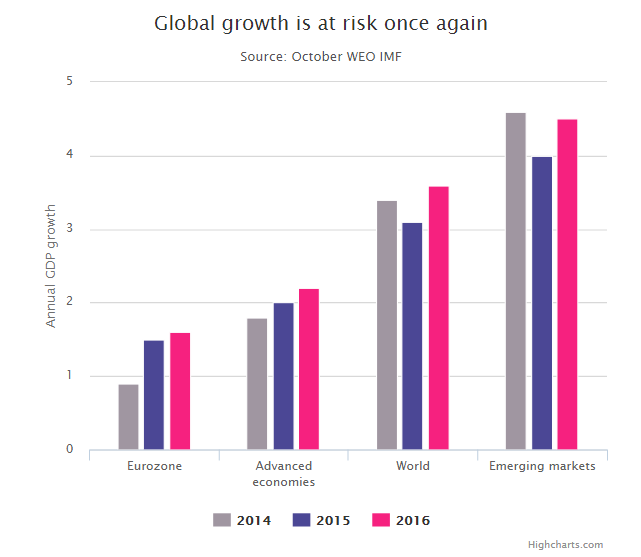
The Fund's financial stability report noted that any "failed normalisation" of interest rates and market conditions would wipe 3pct from the world's economic output over the next two years. The IMF had estimated the global economy will expand by 3.6pct next year, but with rising US interest rates, a Chinese slowdown and disappointing world trade prospects appear slim for major global economic pickup.
"The key question is whether the U.S. economy is finally robust enough not only to sustain its own recovery but also to lift world trade and global growth enough to allow the external deflationary pressures weighing on U.S. inflation to wane," outlined HSBC economists Janet Henry and James Pomeroy.
The IMF has urged both the European Central Bank and the Bank of Japan to continue their unprecedented quantitative easing policies and maintain record low interest rates in an uncertain global environment. Modest growth in developed economies is generating very little inflation and forcing central banks in keeping interest rates low. Moreover, the with scope for oil prices to fall below $30 a barrel in the early months of the year, inflation is likely to remain lower than any of the world's major central banks are anticipating. It will then become harder to raise interest rates if inflation continues to undershoot official forecasts.
Although many emerging market economies have enhanced their policy frameworks and resilience to external shocks, several key economies face substantial domestic imbalances and lower growth. Near-term economic growth looks stronger in advanced economies, compared with the recent past, but weaker in the emerging market and developing economies that account for a growing share of world output and growth. Downside risks to the world economy appear more pronounced than they did just a few months ago, noted IMF in its 'World Economics Outlook'.

- News

- Economy

- Central Banks
- Investing
- Research
- Roundups
- Digital Currency
- Insights
- Technical Analysis
- Technology
- Business
- Law
- Health
- Nature
- Fintech
- Science
- Topic
- Opinions
- ©Econometrics LLC . All Rights Reserved.
Global economic recovery will continue to disappoint in 2016
Thursday, December 31, 2015 10:41 AM UTC
Editor's Picks



- Market Data
Most Popular




