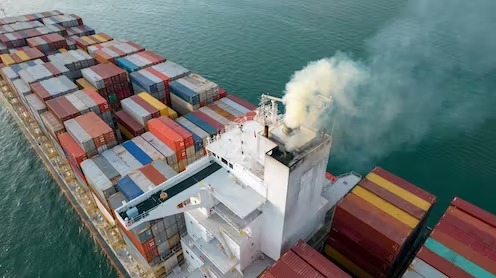
Ships carry around 90% of traded goods and emit about 3% of global CO₂. The International Maritime Organization (IMO), the UN agency responsible for regulating shipping, recently set out plans for this industry to reach net zero emissions by 2050.
Like their ancient forebears, modern vessels can be partially propelled by wind. Indeed, a British cargo ship recently took its maiden voyage using sails made from the same material as wind turbines.
This can reduce a ship’s lifetime emissions, but wind’s ability to power the global shipping fleet is limited by propeller systems, which only provide up to 30% of the energy vessels need to navigate – and even less in poor weather. Wind propellers might assist cargo ships but are unlikely to fully replace fuel engines. What the shipping industry needs is to swap oil for alternative green fuels.
The shipping industry faces great challenges in making this shift to fuels such as ammonia, hydrogen and methanol. While a few companies like Maersk have begun to test them, converting the entire industry will require ramping up renewable energy, creating new globe-spanning fuel distribution networks, overhauling regulatory frameworks and building ship engines that can burn green fuels.
Some of these steps are underway, yet much more remains to be done.
What makes shipping fuel green?
Green hydrogen is produced by splitting water into hydrogen and oxygen using electricity generated by wind, solar or other renewable sources. Green ammonia is formed by combining nitrogen from the air and green hydrogen through a process called Haber-Bosch.
Green methanol is either generated by heating plant or other organic waste to create a gas that can then be converted into bio-methanol, or by combining green hydrogen and captured CO₂ to make e-methanol.
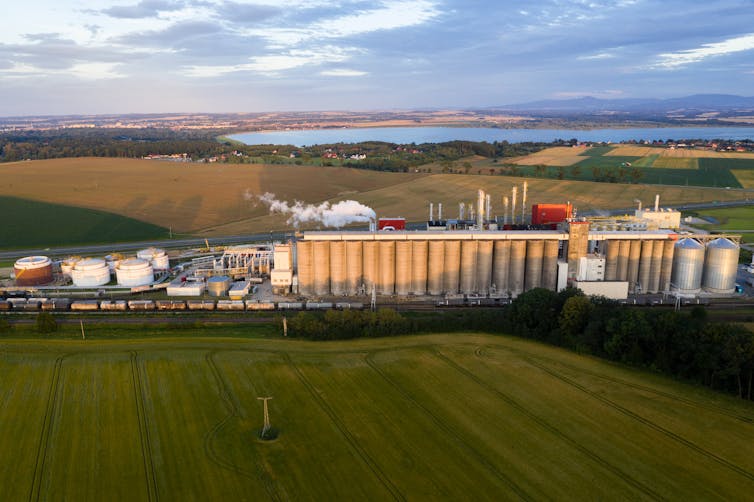
A Polish factory producing methanol from corn. Chawranphoto/Shutterstock
When assessing how green a fuel really is, not only are the emissions created by burning it in the ship’s engine important, but also, the emissions from extracting, producing, transporting and storing it.
This lifecycle assessment of emissions is called “well-to-wake”. In the same way an electric car is not zero-carbon if its power is generated using fossil fuels, nor is a ship using ammonia or methanol produced by burning natural gas.
This assessment demands that the three fuels be generated using only renewable energy. That alone will require enormous investment. According to a study undertaken by the International Chamber of Shipping in 2022, the shipping industry will require up to 3,000 terawatt-hours (TWh) of renewable electricity a year, which almost equals the current global total of wind and solar electricity output (about 3,444 TWh).
This output must be ramped up as other industries, such as steel and cement, will also need zero-emission energy by 2050. In fact, up to US$1.9 trillion (£1.5 trillion) must be invested to fully decarbonise shipping, with over half of that needed to make green hydrogen, which is also essential for producing green methanol and ammonia.
Ships with compatible engines needed…
Vessels that run on oil and diesel cannot simply switch to burning green fuels. The world’s fleet of around 61,000 ships will need to be upgraded or replaced before 2050.
Retrofitting can allow existing vessels to run on methanol and ammonia, but it costs between US$5 million and US$15 million a ship depending on the fuel. Older vessels are likely to reach the end of their service before this investment is paid off and the onerous cost is the same even for smaller ships.
Ships capable of burning both methanol and methane are already being ordered by container shipping lines such as Maersk, Evergreen, CMA CGM and COSCO. Maersk has received its first dual-fuel vessel which burns green methanol and fuel oil, and sailed from South Korea to Denmark with cargo in August 2023.
The first ammonia-ready vessel, Kriti Future, is already sailing the ocean, though it isn’t burning ammonia yet. Vessels powered by hydrogen fuel cells lag behind the other two fuels, yet MSC cruises have ordered two hydrogen-ready vessels for 2028.
While these vessel orders inspire a sense of optimism about decarbonisation, they only account for a very small percentage of the global fleet.
…and so are safety regulations
A lack of safety regulations is partly responsible for the slow uptake of alternative fuels.
Although the International Energy Agency predicts green ammonia will be the most widely used fuel in 2050, shipping companies have placed more orders for vessels powered by methanol and methane. This is partly because the IMO has issued safety regulations for methanol as fuel, but not ammonia and hydrogen, which has cast doubt on their future among shipowners.
For green fuels to be widely adopted they must be at ports worldwide, but none are widely available. There are about 120 ports capable of storing and delivering methanol, but not enough green methanol. Where this fuel is available it’s often secured by private arrangements between a few large shipowners and methanol producers.
According to the Green Methanol Institute, about 0.7 million tonnes of green methanol could be produced globally by the end of 2023. Production capacity is projected to reach 8 million tonnes a year by 2027. But the global shipping industry requires 550 million tonnes by 2050 to replace oil.
There may not be enough farm and food waste to decarbonise all sectors of the global economy. And so the production of fuels from renewable electricity must increase.
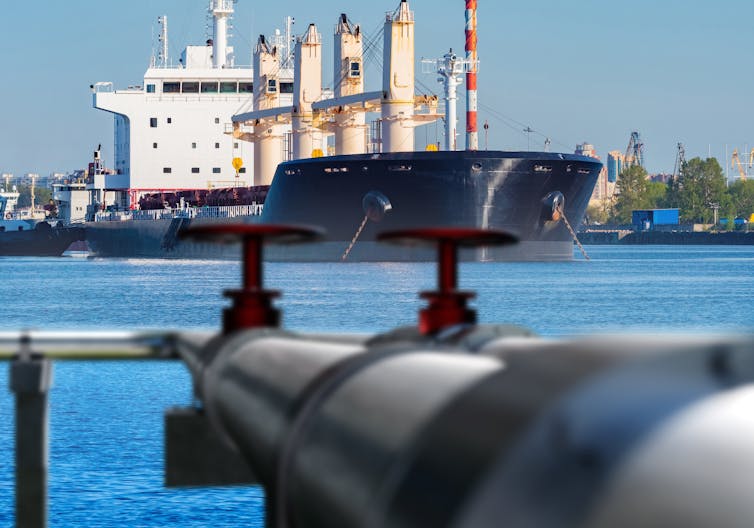
Ports worldwide must change fast to accommodate new fuels. FOTOGRIN/Shutterstock
Lots to build
Rolling out green fuels will also require building pipelines, storage tanks and port refuelling stations. Green hydrogen in particular, the key ingredient for other fuels, will need a large investment as it must be stored in special containers at around −253°C.
The shipping industry has not decided on its fuel of the future. But more than one is necessary considering the limited supply of renewable energy.
The good news is that decarbonising international shipping will benefit more than this vital industry by expediting renewable energy investments and helping sun-rich emerging economies flourish with the chance to make lots of cost-effective green hydrogen.