Not so long ago, the concept of a fully automated store seemed something of a curiosity. Now, in the midst of the COVID-19 pandemic, the idea of relying on computers and robotics, and checking out groceries by simply picking them off the shelf doesn’t seem so peculiar after all.
Part of my research involves looking at how we deal with complex artificial intelligence (AI) systems that can learn and make decisions without any human involvement, and how these types of AI technologies challenge our current understanding of law and its application.
How should we govern these systems that are sometimes called disruptive, and at other times labelled transformative? I am particularly interested in whether — and how — AI technologies amplify the social injustice that exists in society. For example, unregulated facial recognition in the United States affects almost 120 million adults, with no independent testing for biased error rates; this effectively creates a virtual, perpetual line-up for law enforcement.
Current applications
Connected supermarkets, like Amazon Go Grocery, use technology that employs computer vision, sensor fusion and deep learning to eliminate the need for staffed checkouts. These are are the same types of technologies used in self-driving cars. Connected supermarkets have eradicated standing in line ups and the traditional checkout experience, as well as the more recent self-checkout experience.
Other curious innovations used to seem other-worldly, such as autonomous robot cleaners that use ultraviolet light to disinfect hospitals and medical facilities.
Some products raise concerns, like ZoraBot, an elder-care robot. These robots are designed to increase independence and reduce loneliness within the world’s growing elderly population. But there are concerns that the robots are potentially insufficient in terms of proper human companionship.
Technological workforces
Prior to the COVID-19 outbreak, we worried that increased automation would impact our workforce, making us uneasy about losing our jobs to machines. We worried about replacing essential workers such as cleaners with autonomous floor-cleaning robots. We fearfully predicted job loss and out-of-balance allocation of prosperity. A 2017 McKinsey report on the future of labour predicted that between 400 and 800 million people around the world could be displaced by automation by 2030.
But were we worrying about the right things? Could an automated workforce have lessened the economic damage of COVID-19? Could more contactless options at grocery stores have offered cashiers more protection? Could the use of elder-care bots have limited the devastation wrought upon long-term care homes?
There is mounting evidence that technology, in fact, protects humans. The bots, after all, can’t get COVID-19.
Supporting labour forces
Some predict job gains will come with increased automation. In January 2020, prior to the outbreak of the pandemic, the World Economic Forum released a report that estimated 6.1 million opportunities globally would be created between 2020 and 2022 from emerging professions resulting from automation and other applications of technology.
There are also plenty of recent instances where machines have helped humans do their jobs. Bomb disposal robots, for instance, operate as remote presences for soldiers tasked with disabling suspect devices.
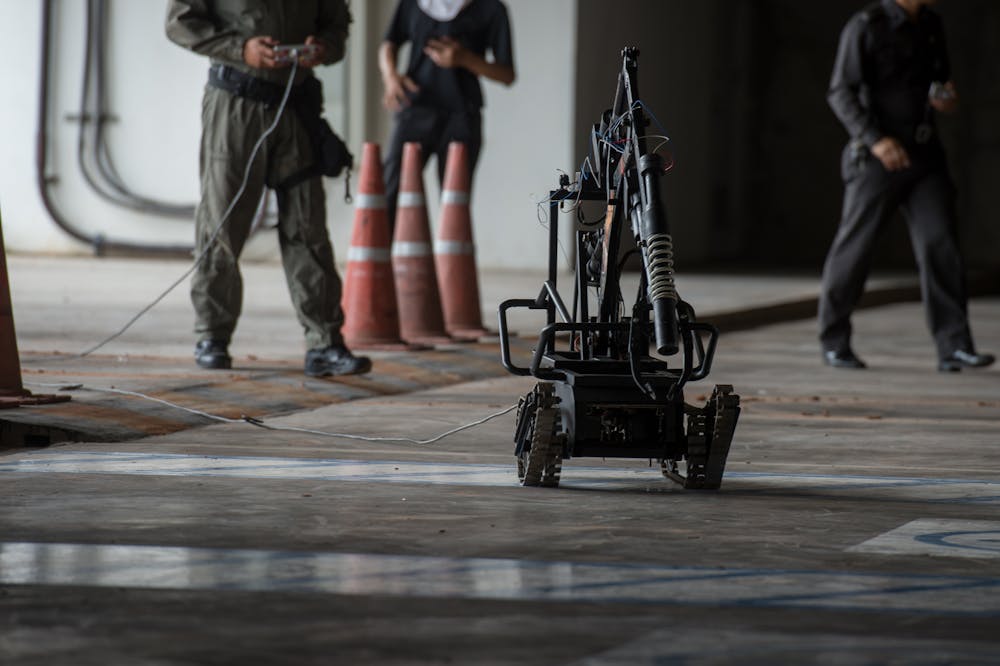
Explosive disposal robot has made bomb detection and removal much safer for people. (Shutterstock)
There are some occupations, however, that are fundamentally human and require quick life-and-death decision making and compassion. Medicine is particularly complicated to automate, but there may be room to use technology for simple tasks such as taking a patient’s temperature.
As we emerge from this crisis, we need to be mindful that automation and employment are not necessarily mutually exclusive — implementing one will not rule out the other. Fear-mongering over the bots-versus-jobs debate obscures the evidence that bots can do things humans can’t: avoid infection by viruses. In fact, our technological curiosities may also constitute a form of caremongering.