The modern world runs on electricity, and wires are what carry that electricity to every light, television, heating system, cellphone and computer on the planet. Unfortunately, on average, about 5% of the power generated at a coal or solar power plant is lost as the electricity is transmitted from the plant to its final destination. This amounts to a US$6 billion loss annually in the U.S. alone.
For decades, scientists have been developing materials called superconductors that transmit electricity with nearly 100% efficiency. I am a physicist who investigates how superconductors work at the atomic level, how current flows at very low temperatures, and how applications such as levitation can be realized. Recently, researchers have made significant progress toward developing superconductors that can function at relatively normal temperatures and pressures.
To see why these recent advances are so exciting and what impact they may have on the world, it’s important to understand how superconducting materials work.

Most materials offer resistance when electricity runs through them and heat up. Resistance is how filaments in an incandescent lightbulb produce light. Ulfbastel/Wikimedia Commons, CC BY-SA
A resistance-free material
A superconductor is any material that conducts electricity without offering any resistance to the flow of the electric current.
This resistance-free attribute of superconductors contrasts dramatically with standard conductors of electricity – like copper or aluminum – which heat up when current passes through them. This is similar to quickly sliding your hand across a smooth, slick surface compared to sliding your hand over a rough rug. The rug generates more friction and, therefore, more heat, too. Electric toasters and older-style incandescent lightbulbs use resistance to produce heat and light, but resistance can pose problems for electronics. Semiconductors have resistance below that of conductors, but still higher than that of superconductors.
Superconductive materials repel magnetic fields, making it possible to levitate a magnet above a superconductor.
Another characteristic of superconductors is that they repel magnetic fields. You may have seen videos of the fascinating result of this effect: It is possible to levitate magnets above a superconductor.
How do superconductors work?
All superconductors are made of materials that are electrically neutral – that is, their atoms contain negatively charged electrons that surround a nucleus with an equal number of positively charged protons.
If you attach one end of a wire to something that is positively charged, and the other end to something that is negatively charged, the system will want to reach equilibrium by moving electrons around. This causes the electrons in the wire to try to move through the material.
At normal temperatures, electrons move in somewhat erratic paths. They can generally succeed in moving through a wire freely, but every once in a while they collide with the nuclei of the material. These collisions are what obstruct the flow of electrons, cause resistance and heat up the material.
The nuclei of all atoms are constantly vibrating. In a superconducting material, instead of flitting around randomly, the moving electrons get passed along from atom to atom in such a way that they keep in sync with the vibrating nuclei. This coordinated movement produces no collisions and, therefore, no resistance and no heat.
The colder a material gets, the more organized the movement of electrons and nuclei becomes. This is why existing superconductors only work at extremely low temperatures.
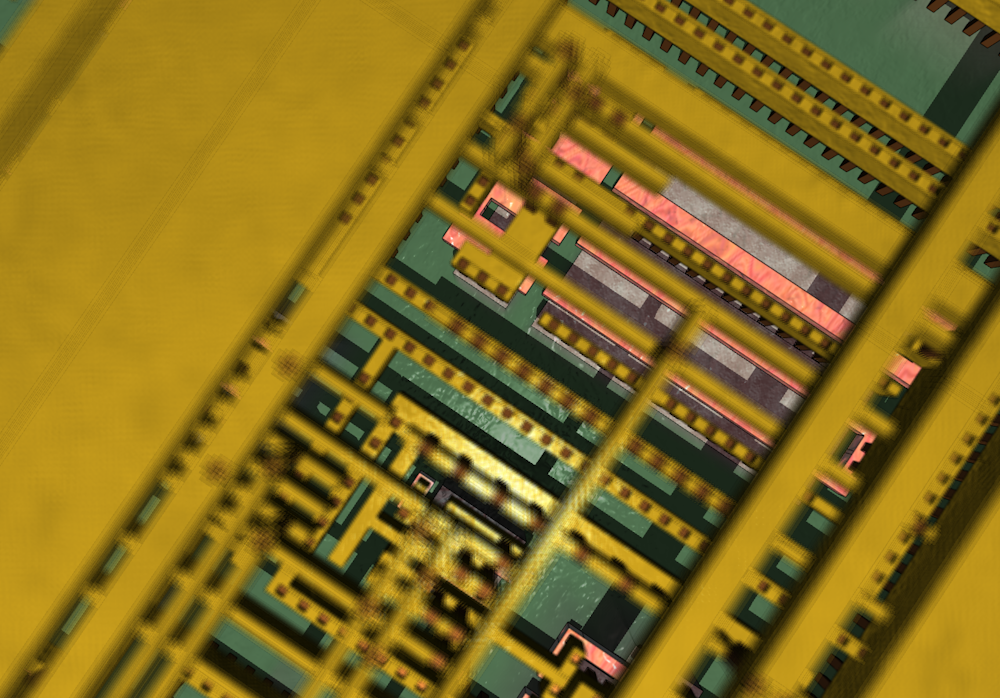
Superconducting materials would allow engineers to fit many more circuits onto a single computer chip. David Carron/Wikimedia Commons, CC BY-SA
Benefits to electronics
If scientists can develop a room-temperature superconducting material, wires and circuitry in electronics would be much more efficient and produce far less heat. The benefits of this would be widespread.
If the wires used to transmit electricity were replaced with superconducting materials, these new lines would be able to carry up to five times as much electricity more efficiently than current cables.
The speed of computers is mostly limited by how many wires can be packed into a single electric circuit on a chip. The density of wires is often limited by waste heat. If engineers could use superconducting wires, they could fit many more wires in a circuit, leading to faster and cheaper electronics.
Finally, with room-temperature superconductors, magnetic levitation could be used for all sorts of applications, from trains to energy-storage devices.
With recent advances providing exciting news, both researchers looking at the fundamental physics of high-temperature superconductivity as well as technologists waiting for new applications are paying attention.