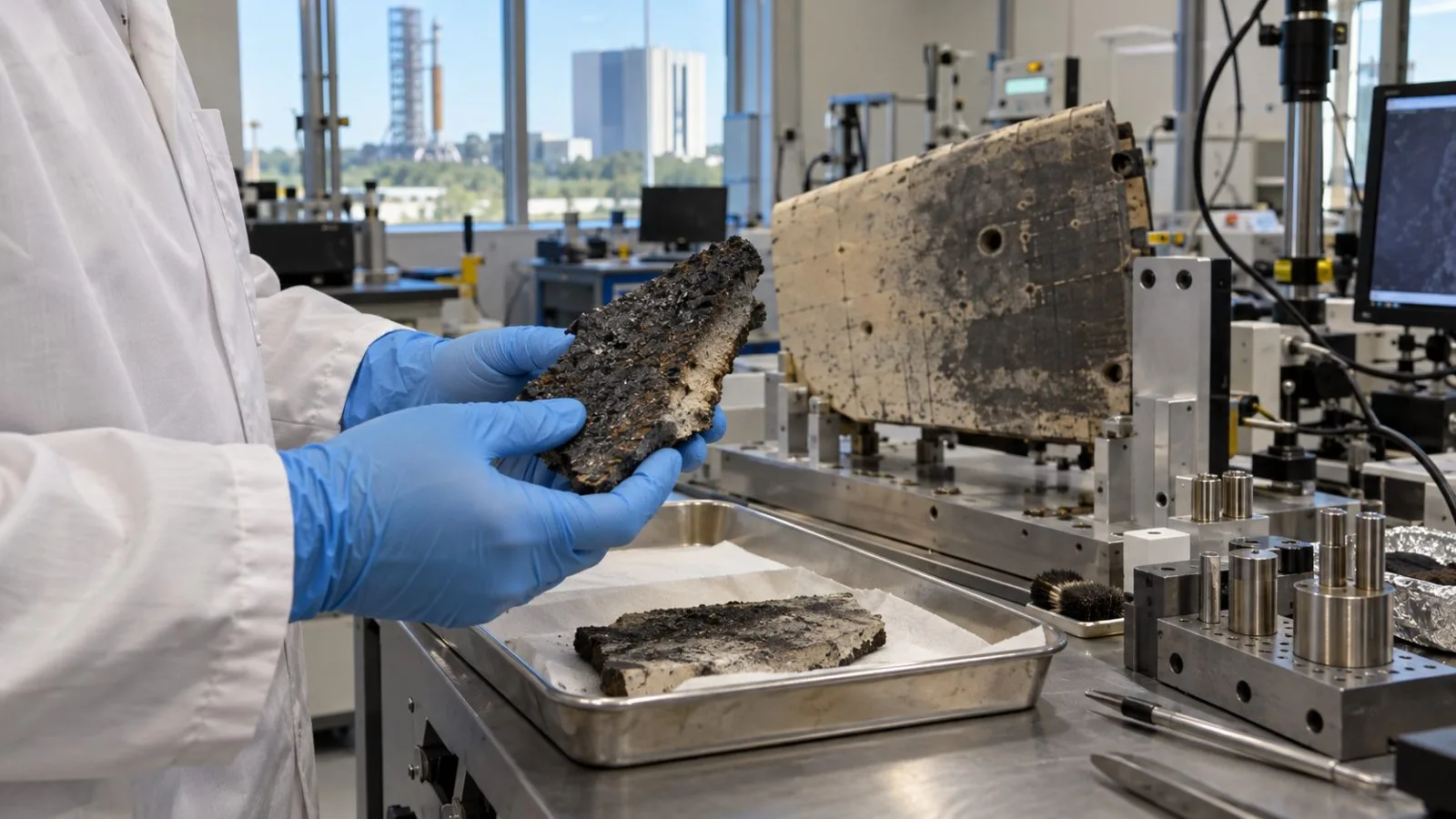
NASA says Orion’s Artemis II heat shield showed far less surface damage than the uncrewed Artemis I shield, a result that informs preparations for future lunar flights as testing continues.
In its Oct. 15 review, NASA said the heat shield and backshell performed as engineers had expected before launch. The Artemis II shield’s dish had nine spots of char loss, compared with 103 on Artemis I. NASA attributed the difference to a shorter permitted downrange flight, saying it lowered both cracking and char loss to one-tenth of Artemis I’s levels.
Orion carried four astronauts around the Moon and splashed down on April 10, 2026. NASA said the capsule’s top speed reached 39 times the speed of sound. Temperatures on its exterior exceeded 4,000 degrees Fahrenheit, while cabin readings remained in the mid-70s Fahrenheit.
The revised route followed damage to the heat shield during Artemis I, which returned on Dec. 11, 2022. A NASA technical conference abstract says investigators linked the earlier cracking and char loss to gas pressure trapped inside low-permeability Avcoat during the spacecraft’s skip entry. Artemis II’s route omitted that maneuver, changing the conditions the shield encountered on its return.
Orion’s heat shield uses 186 blocks of Avcoat, an ablative material that wears away while absorbing heat. NASA also reported expected performance from the backshell, which is covered by 1,300 ceramic tiles. Checks around the capsule’s hatch, windows, vents and thrusters found no evidence of overheating.
At NASA’s Marshall Space Flight Center, teams began removing samples and taking internal X-ray scans in August. They are comparing postflight laser scans with preflight measurements to determine how much shield material receded; material testing and thermal analysis are also continuing.
NASA said the Artemis III heat shield design has been upgraded to improve Avcoat block uniformity and make permeability more consistent. A NASA technical abstract says Artemis III and later missions are planned to use a more permeable version of Avcoat.