Rapid urban population growth is driving many cities around the world to reduce their carbon footprints. In Canada, two major policy agendas are designed to achieve this: boosting urban density and promoting low-carbon transportation such as electric vehicles (EVs).
Despite their overlap, these goals are often pursued separately through disjointed planning strategies. In time, ad-hoc policies could be counterproductive and stall the shift to EVs, by making ownership expensive, inefficient and complicated.
Most Canadians live in cities, where the deployment of EVs has two main advantages.
First, EVs can drastically reduce local emissions as long as their electricity comes from sustainable sources. Second, their driving ranges are suited to short urban trips. For example, 95 per cent of driving trips in Vancouver are less than 30 kilometres, well within the range of an EV.
However, as cities swap single-family homes for multi-unit dwellings to increase population density, reduce housing prices and lower carbon emissions, the installation of EV charging stations in existing multi-unit dwellings is lagging behind. Our research found ways to change that.
EV sales on the rise in British Columbia
British Columbia is an attractive location for EVs because roughly 90 per cent of the province’s electricity comes from large renewable hydropower. Widespread EV usage could cut B.C.‘s greenhouse gas emissions by up to 98 per cent. Residential electricity rates in B.C. are now low enough that charging a vehicle at home is less expensive than fuelling a conventional gasoline vehicle.
Together with B.C.’s EV subsidies, these factors more than doubled provincial EV sales between 2013 and 2017. However, EVs still make up only two per cent of all vehicles on B.C.’s roads. What’s more, B.C.’s current regulations mean that EVs will likely only have a 10 per cent market share by 2040, far below the Canadian government’s goal of 30 per cent by 2030. This suggests more stringent policies are needed.
Consumers are switching to EVs as the number of models on the market grows and battery prices decrease, but drivers want to be sure they will be able to charge their vehicles quickly, easily and cheaply.
Electrified transportation is still beset by the classic chicken-and-egg problem: fuel providers will not invest in fuelling infrastructure until enough EVs are in circulation, and people will avoid buying an EV until sufficient charging points exist.
Few incentives to retrofit
While a dense network of public charging points will be important for reducing range anxiety among users, almost 90 per cent of charging takes place at home. Yet the installation of home charging stations is complicated in buildings with multiple dwelling units, because of competing interests in the common spaces shared by residents. So-called “Multi-Unit Residential Buildings” now account for over a quarter of all households in B.C. and are forecast to make up 70 per cent of all new residential constructions in the province by 2020.
As of 2019, all new multi-family residential developments built in Vancouver must include EV charging infrastructure. But the city has no policies to encourage building owners to retrofit existing buildings with charging points.
Our research found financial and technical issues were the most significant barriers to installing charging points in multi-unit residential buildings, mostly due to the imposing electrical loads EV charging stations place on the buildings’ existing power systems. Other barriers include the lack of support from non-EV drivers, unclear regulation concerning the rights and obligations of drivers and landlords, and overly conservative regulatory requirements for buildings.
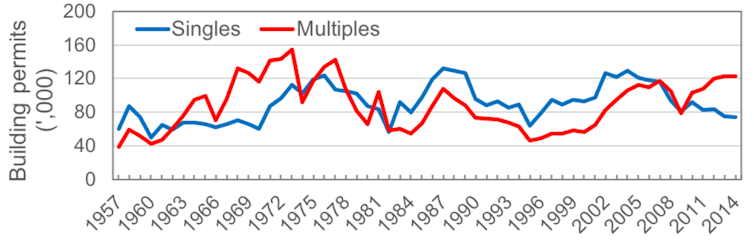
B.C. building permits for multiple unit residences are on an upward trend. Data from Statistics Canada
Breaking down barriers
Municipal governments throughout B.C. could break down these barriers with a few key policy changes.
They could start by introducing financial policies that create incentives for both EV owners and building owners. So-called “demand-focused” policies include programs that provide financial aid to building owners to develop retrofit plans, and to mandate them to retrofit a minimum number of charging stations. EV ownership could be incentivized through rebates that cover the cost of a new vehicle: B.C. already offers rebates of up to $5,000, but this is much lower than in Québec.
Municipal governments should also clarify the rights and obligations of builders, building owners, residents and others when it comes to charging infrastructure. For instance, who should pay for the installation and running costs of charging points in condos? What sort of upgrades are needed to deal with the extra electrical loads from EV charging?
Non-governmental associations such as the Condominium Home Owners Association of B.C. and the Building Owners and Managers Association of B.C. offer some guidance, but confusion remains.
Finally, governments can help raise public awareness and acceptance of EVs by introducing programs to educate people who have less trust in, and understanding of, EV technology.
Many municipalities around the world could adopt these suggestions to encourage the installation of at-home EV charging points, while also boosting urban density.
Cities generate 80 per cent of global GDP and are responsible for 70 per cent of carbon dioxide emissions, so they are critical arenas for addressing the sources and effects of climate change.
As vehicle electrification gains ground in Canada and elsewhere, we will need policies that do a better job of recognizing the obstacles and opportunities around residential charging. The high densification and mobility challenges experienced in B.C.‘s urban areas illustrates the challenges faced by many modern cities.
This piece was written in conjunction with Diana Lopez-Behar, Martino Tran, Thomas Froese, Omar Herrera and Walter Merida (University of British Columbia).