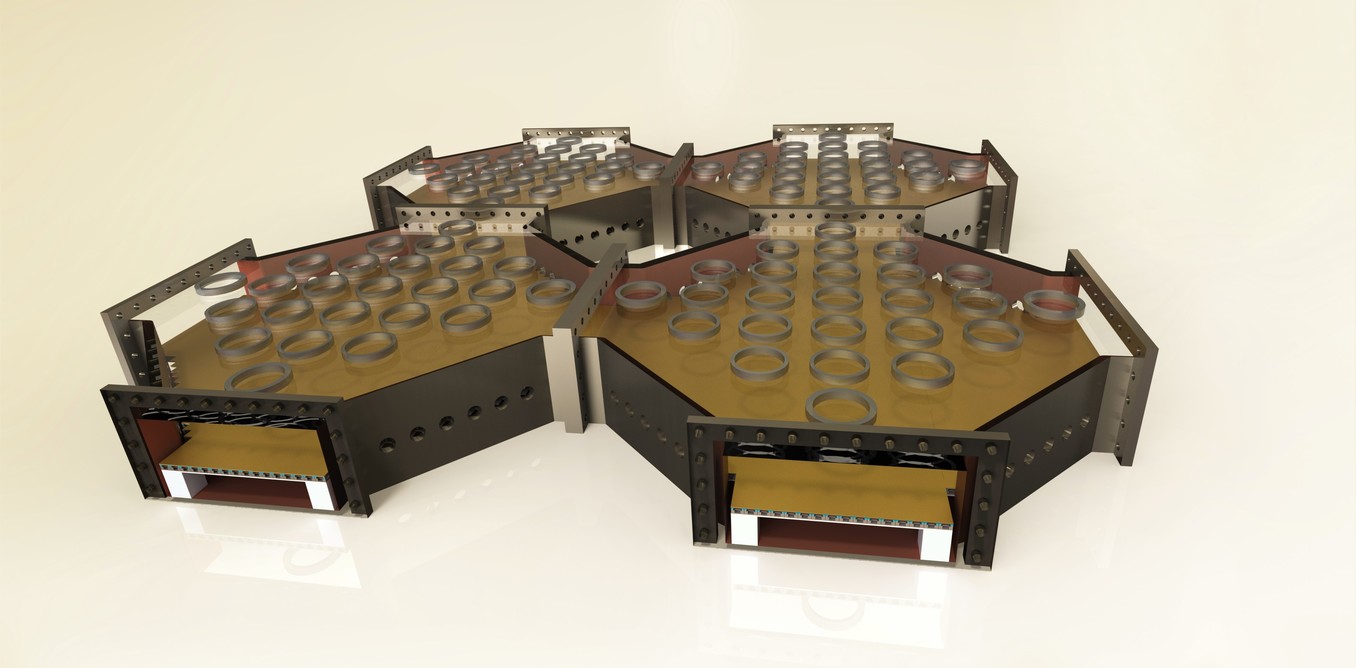
Quantum computers, which are based on the strange rules of quantum mechanics, will revolutionise society in a similar way to how mechanical computers have. Once built, they will help us answer many questions in science, create lifesaving medicines, provide transformative capabilities for the financial sector and just in general solve certain problems that an ordinary computer would take billions of years to compute.
It is very difficult to estimate the full impact of quantum computers, as we are only starting to develop a new class of algorithms that may run on such a machine. However, one thing is clear. Nature works according to quantum physics, so quantum computers may be the very best tool possible to understand nature and the fabric of reality itself.
So far, most of the research into quantum computing has been academic. But we have now managed to draw up an actual nuts and bolts construction plan to build a large-scale quantum computer, published in the journal Science Advances. While small-scale quantum computers have already been built (for example, at the University of Sussex) they only demonstrate some of the physics involved and are too small to solve some of the more interesting problems.
Quantum weirdness
Quantum computers work by exploiting so-called quantum effects. One of the most important ones is “superposition” – the fact that an object can be in two different places at the same time. Yes, you heard right! But what does that even mean? Does this enable me to have a holiday in sunny California and at the same time write this article in the UK?
Not quite, we mostly see quantum effects on the “microcosmos” level of atoms and molecules. For example, physicists around the world have managed to conduct studies showing an atom can be in two different places at the same time. However, such experiments are very difficult because even the slightest contact between an atom exhibiting quantum effects and anything else will make these effects disappear – immediately.
This is why it is so difficult to build an actual quantum computer and why it’s easier to build small prototypes. So far, the leading technology thought to be capable of building a quantum computer are trapped ions (atoms that have lost an electron, making them charged) that are trapped by electric fields. This is what we have used.
In the same way as a conventional computer encodes information as a series of 0’s and 1’s, also referred to as bits, a quantum computer makes use of quantum bits, which can be zero and one at the same time – giving enormous processing power! Within a trapped ion quantum computer, each ion corresponds to one quantum bit.
Animation illustrating the system design and operation of a large scale quantum computer.
So a quantum computer with a billion quantum bits requires a billion trapped ions. These ions are held levitating above a quantum microchip using electric fields. To operate a quantum computer is just like playing a game of Pacman – just check out the video above. The quantum microchip acts like a computer mother board with the ions being transported using electric fields from memory regions to processing regions and beyond.
Ambitious plan
For many years, I have seen smiles or disbelief on the faces of some of my colleagues when I told them about our intention to build a large scale quantum computer. But with with tremendous progress in the field in the last few years, (here is an example from my group at Sussex), more people are starting to believe it may actually be achievable.
Our mission was to come up with the simplest technology solution possible and to make use of proven technology wherever possible. We wanted to identify the most important engineering challenges and deliver credible solutions. In order to make this happen, I enlisted some extremely talented scientists from around the world to help us to draw up a blueprint.
We did not just want to write another academic study. So we tried to focus on the actual engineering. How big will it be? What about the power consumption? What parts does it require? What kind of cooling does it need? Providing all these details was a very tedious process, but it provides the answer to the most important question: can such a device actually be built? And while we still believe it will be quite an engineering feat, tremendously expensive and requiring a lot of people, I think it is fair to say that the answer is yes.
We kept the paper on an archive server accessible to other scientists for several years. This allowed us to gather critical feedback and by addressing this feedback further refine the plan. Have we really addressed all possible problems? We cannot know for sure, but so far I have not heard any substantial criticism that we believe cannot be addressed.
Explaining the concept.
So let’s talk about the actual blueprint. A quantum computer needs to be constructed from many individual modules. Why? Because if you just use one module, the ultimate processing power will always be limited by the largest module size that could be constructed with current technology. What we developed is a concept where the quantum computer consists of many modules and ions can be transported from one module to another using electric fields in order to connect the modules to perform difficult calculations. Using this approach is a lot simpler than previously proposed ideas to connect modules.
One of these ideas had been to connect individual quantum computer modules using optical fibres. In order for that to work, quantum bits need to be exchanged making use of individual particles of light, so called photons. This is still quite a slow process, although I’m confident it will be improved with some time and effort. But for now, we instead made use of a new invention transporting actual ions from one module to another using electric fields. This makes it possible to operate the computer at room temperature, unlike alternative “superconducting” designs (where electricity can flow with close to zero resistance), which only work at very low temperatures.
We aim to construct really powerful quantum computers that will fill a building or maybe even a football pitch and use a lot of power. The development cost is hard to estimate but might be in the range of £100m.
But, at least with this technical plan, we believe a large-scale quantum computer is not the stuff of science fiction movies anymore. Even though I should stress that it still is very hard!
 Winfried Hensinger receives funding from the EPSRC; the U.K. Quantum Technology hub for Networked Quantum Information Technologies and the U.K. Quantum Technology hub for Sensors and Metrology, the U.S. Army Research Office under contract no. W911NF-14-2-0106, DSTL.