


 Gold Prices Fall Amid Rate Jitters; Copper Steady as China Stimulus Eyed
  Wall Street Closes Lower as Bank Earnings and AI Concerns Weigh
  UBS Predicts Potential Fed Rate Cut Amid Strong US Economic Data
  Lithium Market Poised for Recovery Amid Supply Cuts and Rising Demand
  Oil Prices Fall as Trump Ceasefire Claim Shifts Market Focus to U.S. CPI
  2025 Market Outlook: Key January Events to Watch
  Trump Defends Russian Diesel Deal Amid US Sanctions Backlash
  China’s Growth Faces Structural Challenges Amid Doubts Over Data
  UK Finance Minister Healey Calls for Fiscal Discipline Amid Global Risks
  Oil Prices Fall as Russia Signals Higher Diesel Exports
  Asian Currencies Steady as Dollar Nears 18-Month High Ahead of US CPI
  Goldman Predicts 50% Odds of 10% U.S. Tariff on Copper by Q1 Close
  Philippines Current Account Deficit Seen at $19.1 Billion in 2026
  Moldova Criticizes Russia Amid Transdniestria Energy Crisis
  Indonesia Surprises Markets with Interest Rate Cut Amid Currency Pressure
  IMF Maintains 2027 Global Growth Forecast at 3.4% Amid Rising Risks


 Add as a preferred source on Google
Disclaimer: This is not investment advice. The information provided is for general purposes only. No information, materials, services and other content provided on this page constitute a solicitation, recommendation, endorsement, or any financial, investment, or other advice. Seek independent professional consultation in the form of legal, financial, and fiscal advice before making any investment decision.
Gold and stocks tumbled after Iran attacked Israel. The yellow metal lost more than 4% on Friday and the US major indices, the S&P500 declined more than 1.80%.
Impact on Gold
Iran attacked Israel using more than 300 drones and missiles in retaliation for an Israeli attack on the Iranian consulate in Damascus. Markets are awaiting Israel's reaction to Iran's attacks for further direction. Any further strikes by Israel will lead to geo-political tension in the Middle East. It will affect global crude oil supplies and push global inflation higher. The Fed rate cut in June faded away as inflation remains hot due to US crude oil supply disruptions.
The war will have a positive impact on gold as demand for safe-haven assets increases in the Iran-Israel war.
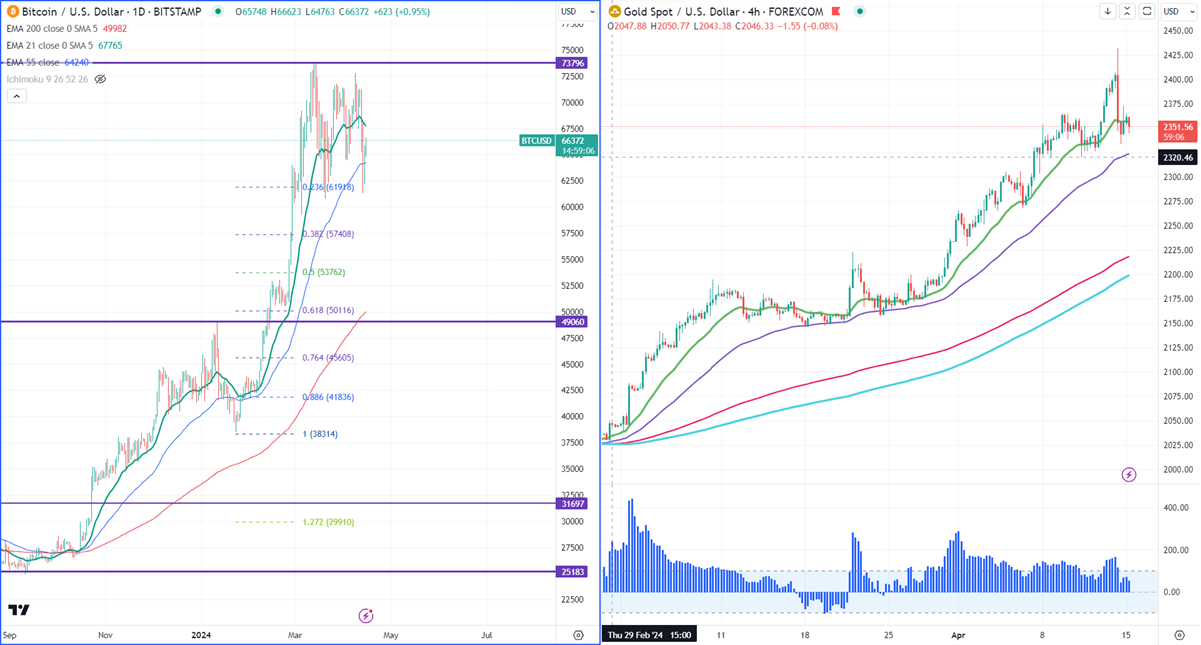
The immediate support to watch out - $2325 and any violation below confirms minor bearishness, a decline to $2300/$2270 (21-day EMA). Any close below $2270 will drag the pair to $2225/$2200.
The near-term resistance is around $2375 and any breach above targets $2400/$2450.
It is good to buy on dips around $2270 with SL around $2225 for TP of $2450.
Stocks (negative impact)
The major US stock indices showed a dismal sell-off on Friday. The markets' sentiment was hurt by stronger-than-expected US inflation and Iran's attack on Israel. The war is expected to hurt global stock markets. The jump in inflation due to the escalation of Middle East tension will prevent central banks from rate cuts.
S&P500 near-term support is around 5080 and any violation below will drag the index to 5042/5000/4945. The immediate resistance is 5200 and any violation above targets 5250/5275.
Bitcoin
BTCUSD tumbled more than 10% due to upbeat US inflation and the Iran and Israel war. The escalation of Middle East tension will hurt Crypto markets. Investors are expected to square off positions in riskier assets and invest in safe-haven assets like the US dollar, Swiss Franc, and Gold.
BTCUSD near-term support is around $63000 and any violation below will drag it to $61300/$60000/$59000/$57400/$55000. The immediate resistance is $67000 and any violation above targets of $70000/$72750/$73670.
It is good to sell on rallies around $69980-$70000 with SL around $73500 for TP of $60000/$57400.







