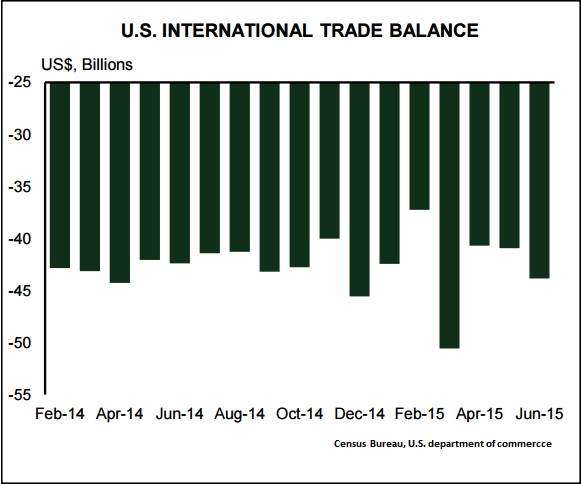
The US trade deficit is projected to turn down remarkably in July, narrowing to $41.81B from $43.84B the month before, with import activity falling on account of falling energy prices while export activity should rise modestly. This will mark the first improvement in the deficit since April.
Earlier post was up about $2.9 billion from $40.9 billion in May, revised. June exports were $188.6 billion, $0.1 billion less than May exports. June imports were $232.4 billion, $2.8 billion more than May imports.
But this time, export activity should rise on the month, posting a 0.4% MoM advance, bolstered in large part by improving global demand. Import activity is likely to decelerate by 0.55% MoM in July as the continuation of the decline on oil prices dampens the import bill.
In the coming months, we expect the improvement in the trade balance to be sustained as lower energy prices continue to keep the energy import bill low, but expect a stronger USD to weigh on exports.
Release Date: September 3, 2015 June Result: -$43.8B TD Forecast: -$41.8B Consensus: -$44.5B.