


 Albertsons Seeks $9.3 Billion From Kroger Over Failed Merger
  Arthur Hayes Announces FLOP Testnet Launch Within Weeks
  US Suspends Microsoft, Adobe From Green Card Program
  Amazon Cuts More Jobs as AI Investment Expands
  Most Americans Oppose Election Betting on Prediction Markets, Poll Finds
  OpenAI Revenue Hits $50 Billion, Below Earlier $70 Billion Estimate
  Syndax Stock Drops 15% After Axatilimab Trial Failure
  OpenAI Annualized Revenue Hits $50 Billion, Below Earlier Estimates
  Ethereum Foundation-Linked Wallets Move $11.13M in ETH to Kraken
  Nasdaq Faces Pullback to 26,225 Despite Bullish Outlook, UBS Says
  Anthropic Launches Claude Dashboards and Motion AI Tools
  Apple Cuts iPhone 18 Pro Production Orders Amid Weak Demand
  Amazon in Talks to Acquire AI Startup Decart for $7 Billion
  Trump Buys Up to $25M in Meta Stock, Invests in SpaceX Debt
  Elon Musk Accuses Indian Telecom Giants of Blocking Starlink Launch
  Elon Musk Eyes Semiconductor Manufacturing Expansion With $15 Billion Terrafab Project
  Elon Musk Donates $366 Million to 2026 US Midterms


 Add as a preferred source on Google
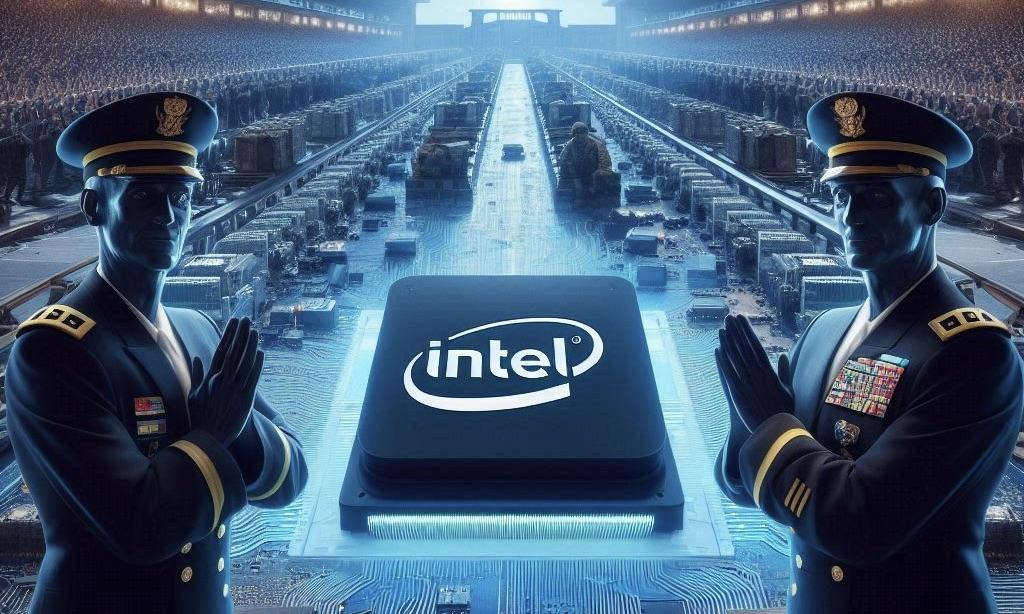
Intel has secured a $3.5 billion grant from the U.S. Department of Defense under the "Secure Enclave" program. The funding aims to support the production of advanced semiconductors for strategic defense needs, offering Intel a crucial boost amid recent stock struggles and uncertain CHIPS Act funding.
Intel's $3.5 Billion DOD Agreement Aims to Revitalize Sentiment Amid CHIPS Act Funding Challenges
Intel eventually received a rare boost from a secretive U.S. Department of Defense (DOD) program following weeks of unfavorable developments that have negatively impacted its stock performance. According to Wccftech, this development could significantly influence the stabilization of the company's declining sentiment.
According to Bloomberg, Intel has executed a legally binding agreement under the Department of Defense's "Secure Enclave" initiative. The agreement, which will grant the chipmaker $3.5 billion in federal funding, is a significant step towards promoting the production of sophisticated semiconductors for strategic defense purposes. This could open up new avenues for Intel and bolster its position in the industry.
Intel needs to work on obtaining the anticipated funding from the CHIPS Act, a critical source of federal support. Consequently, this encouraging news is timely. Intel is expected to receive $8.5 billion in grants and $11 billion in financing under the CHIPS Act, provided it establishes a substantial manufacturing presence in the United States. However, the company is purportedly unable to fulfill the initial expectations due to [specific reasons], which has resulted in protracted negotiations.
Intel’s Revival Plan Includes Major Asset Sales and Cost-Cutting as Stock Struggles Persist
Intel is preparing to present a revival strategy at its upcoming board meeting in response to these challenges. The strategy, which is anticipated to involve the sale of its majority stake in Altera, its FPGA arm, the suspension of construction at its $30 billion German facility, and the prospective sale of its Foundry division to Qualcomm, could significantly impact the company's financial performance.
In addition, Intel has instituted cost-cutting measures, such as reducing its dividend, downsizing its workforce by 13.6%, and reducing its 2025 capital spending by 17% to $21.5 billion.
After the Department of Defense's announcement, Intel shares experienced a 1% increase in after-hours trading. Nevertheless, the stock has declined by 59 percent for the year.







