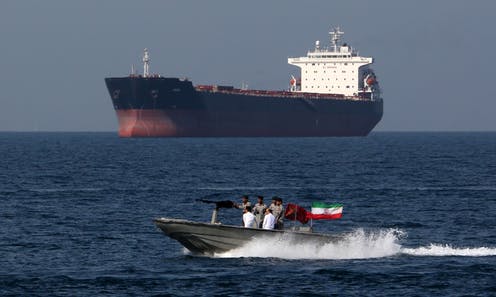
Iran launched new attacks on U.S. military facilities in the Gulf on Friday after the United States carried out a sixth straight night of strikes on Iranian military targets, deepening a conflict that has unraveled last month’s truce.
The U.S. military said its latest operation targeted key Iranian military infrastructure, including facilities on Qeshm Island and near Bandar Abbas, home to Iran’s largest port and important naval and Islamic Revolutionary Guard Corps bases. U.S. Central Command said fighter jets, drones, and warships struck coastal surveillance systems, air defense sites, logistics infrastructure, and maritime assets in an effort to weaken Iran’s military capabilities.
In response, Iran launched missiles and drones toward U.S. bases across the region. Iranian forces said they struck American facilities in Bahrain and Kuwait early Friday, while witnesses reported explosion-like sounds in Doha, Qatar. Qatar’s Interior Ministry said a child was injured by shrapnel. Reuters could not independently verify the reported attacks.
Iranian state media also reported that U.S. strikes hit five bridges, Bandar Khamir’s train station, and Iranshahr Airport. State news agency IRNA said seven people were killed after bridges in the southern port city of Bandar Khamir were struck.
The renewed fighting has once again disrupted shipping through the Strait of Hormuz, one of the world’s most critical oil and gas transit routes, fueling concerns over global energy supplies and pushing oil prices higher. Iran has reinstated its blockade of the strategic waterway, while Washington has resumed restrictions on Iranian ports.
According to Reuters sources, Tehran has also warned it could encourage Yemen’s Houthi movement to target the Bab al-Mandeb Strait if U.S. attacks continue. White House Press Secretary Karoline Leavitt said President Donald Trump would not allow attacks on commercial shipping to continue unchecked but remained open to diplomatic negotiations.
Iranian officials said their objective is to reinforce control over the Strait of Hormuz while avoiding a wider conflict that could destroy the memorandum of understanding reached in June. Meanwhile, many Iranians expressed concern over the renewed violence, hoping diplomacy can prevent another full-scale war.
President Trump has also warned that additional U.S. military action, including possible strikes on Iranian infrastructure, could follow unless Tehran returns to negotiations.