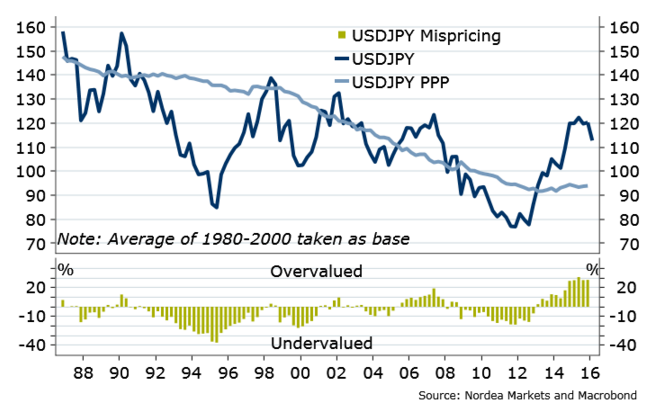
The Japanese Yen has indeed been the best currency this year, strengthened 7% in nominal effective terms, seemingly at a much faster rate. The positioning has flipped since the beginning of the year, correcting quickly. Market is now net long the JPY: the speculative net long positions are the largest seen since 2011. CFTC data of IMM Net Speculators' Positioning as at 16 February 2016 showed that JPY longs increased again last week on the back of safe haven demand although they are below their recent highs.
In the option space, risk reversals for the JPY are skewed toward JPY strength against the USD, unlike for other major currencies. This creates the bias for the change in direction towards a weaker JPY in the short term. That said, long-term valuation models such as PPP suggest that USD/JPY should trade around 95. The shorter models based on real interest rate spreads suggest "fair value" around 105. This is where the JPY is likely to be heading eventually.
"Only a scenario with USD short rates rising by more than 100bp would, ceteris paribus, justify a USD/JPY fair value above current market levels", says Nordea Markets.
JPY strength is primarily attributable to three reasons - 'the valuation, the positioning and the Asian turbulence'. Risk-off environment in Asia is good for the Yen, as it causes repatriation flows. That explains the JPY strengthening during times of CNY weakness. Thus, as Asian risks subside and as China shows improvement through better manufacturing data and inflation dynamics, the Yen should weaken. But from a longer term perspective, the JPY still remains a cheap major currency, and the Asian risks haven't totally disappeared. The current account flow is still JPY positive and will remain close to 3% of GDP this year and likely next few years.
The Bank of Japan's foray into negative interest rate territory has done little to stop JPY strength. Even FX interventions might not be effective until risk sentiment improves. In fact, further monetary policy easing could actually be consistent with more JPY strength, as the reasons for cutting rates would be turmoil in Asia, US recession etc - that is, the best conditions for JPY strength. "Underlying" inflation, however, has been edging higher (latest reading: 1.3% y/y), giving the BoJ little reason to act aggressively in the near term. So there are still reasons to keep the JPY on a "buy".
"We maintain our USD/JPY forecasts of 122, 125 and 130 in 3, 6 and 12 months. The current GSDEER for for USD/JPY is 102." said Goldman Sachs in a report.
The bid tone around JPY strengthened further in the European session today. USD/JPY slumped below the 112 handle to trade at 111.91 at the time of writing (1030 GMT).