Federal Reserve (FED) is about to hike rates this year after almost 9 years since the last rise. Current rate is maintained close to zero percent. The most probable next hike would be to bring the Fed funds rate to range…
Federal Reserve (FED) is about to hike rates this year after almost 9 years since the last rise. Current rate is maintained close to zero percent. The most probable next hike would be to bring the Fed funds rate to range of 0.25%.
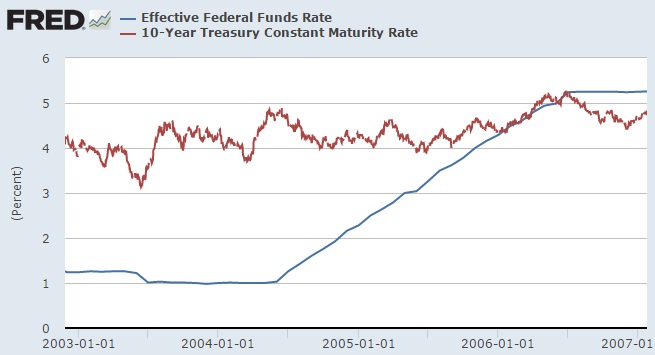
FED raised rates in 2004 from 1% to 5.25% by 2006. During which performance of the asset class remained mixed.
Dollar index traded within a range between 80 to 90. So FED raising rates not necessarily mean a strong dollar, but this time it could be different as the major central banks' monetary policies are diverging unlike then.
The attached chart explains the relation of the longer end treasury namely 10 year yield with FED funds rate for the period of previous rate hike, during which the FED funds rate saw rise of 425 basis points, whereas the treasury yields moved only 50 basis points.
This may not hold true completely this time, as the yield differential between the FED and the 10 year was much larger than the current.
Still, it may be unwise to bet heavily against the longer end, once the FED actually begins.
Partial curve steepening could occur at some point ahead, however more could be parallel shifts.
Australia's September 2026 labour report shocked to the negative: unemployment climbed to 4.7% from 4.6% and employment dropped by 39,300 against expectations for a 20,000 increase. Part-time work dropped by 73,700, whic…
UNCX Network, a cryptocurrency token vesting platform formerly known as UniCrypt, suffered a security exploit on Wednesday that drained approximately $86,000 from its shared Ethereum token pool. Blockchain security firm …
Solana is preparing to introduce its highly anticipated Alpenglow consensus upgrade on October 21, 2026, marking one of the blockchain's biggest technological changes since its launch in 2020. The upgrade aims to signifi…