


 Oil Prices Rise as Gulf Hurricane and Middle East Supply Risks Mount
  BOJ Raises Interest Rate to 31-Year High as Yen Weakens
  Fed’s Williams Signals One More Rate Hike Before Year-End
  Gold Prices Rise as Hormuz Tensions Fuel Inflation Risks
  US-Led Coalition Targets Global Factory Overcapacity
  Fed Unveils Stablecoin Rules Under GENIUS Act
  European Stocks Fall as Oil Rises Ahead of Fed Minutes
  China Shuts 670 Banks as Bitcoin Eyes Financial Risks
  ECB May Stop Rate Hikes After December, Capital Economics Says
  Dollar Near 18-Month High as Euro, Yen and Pound Weaken
  Ethereum Price Drops Below $2,600 as Long Liquidations Hit 4-Month High
  US Treasury Yields Ease After Strong 10-Year Auction as Global Bonds Struggle


 Add as a preferred source on Google
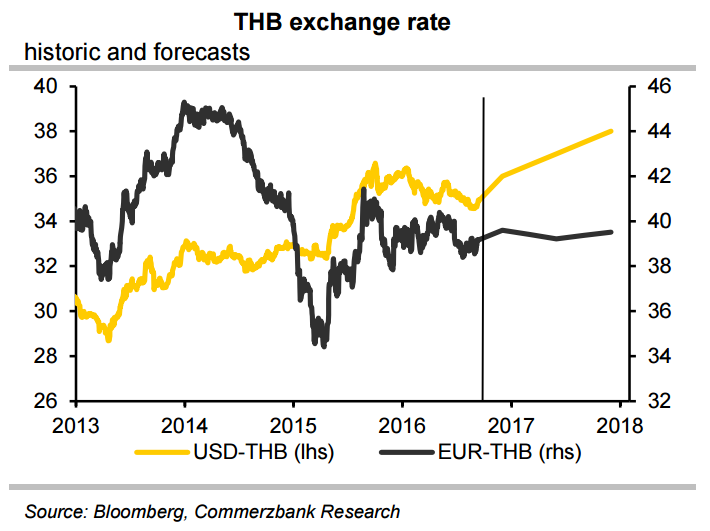
Bank of Thailand (BoT) has kept its interest rate unchanged at 1.5 percent since June 2015. The central bank is more inclined to maintaining loose monetary conditions via a weaker THB rather than lower rates. And with two central bank meetings remaining for this year (in November and December), we see little probability of another cut in 2016.
Thailand's headline inflation was -0.9 percent in 2015 and the nation continues to face disinflationary pressures. Given the modest economic recovery and low oil prices, analysts expect inflation to stay around 0 percent and 0.8 percent in 2016 and 2017 respectively, which is still at the lower end of BoT’s 1-4 percent medium-term target for headline inflation. However, BoT has downplayed the deflationary risks, stating that core inflation is still holding around 1 percent.
After growing by a mere 0.9 percent in 2014 due to political uncertainty, Thailand's economy is expected to expand by a respectable 3.1 percent in 2016 from 2.8 percent in 2015. The domestic sector is likely to be the main driver. However, the buildup in household debt may constrain domestic consumption. That said, government's support to large scale infrastructure projects and continued political stability could help revive investment spending and see a more sustainable recovery.
In H1 2016, the economy grew 3.4 percent and the government is projecting a growth of 3–3.5 percent for the year 2016. Commerzbank currently projects 2017 growth of 3.2 percent.
A broadly stronger USD on the back of rising hopes of a Fed rate hike, BoT’s preference for a weaker THB and persistent political uncertainty have weighed on the THB. THB was the third worst performing currency in Asia in 2015 and on account of the above-mentioned reasons is likely to remain on a weakening trend. Commerzbank forecasts USD-THB at 36.00 by end-2016.
USD/THB was 0.73 percent higher on the day. The pair was trading at 35.72 at around 12:00 GMT. Technical indicators suggest further upside. 20-period weekly MA at 34.96 is major support on the downside. Weakness could resume only on break below. On the upside we see next hurdle at 35.80 levels. Break above will see test of 36.67 levels.







