

As a middle-aged professor who was recently tattooed as part of a study of tattoo artists in Sydney, Australia, I was interested to learn that I could now, despite my inked skin, join the ranks of the London-based Metropolitan Police.
The decision taken in September 2018 by Cressida Dick, the Met’s commissioner, to relax its tattoo policy and allow officers to show body art, not only indicates a greater level of acceptability of tattoos but also reflects the difficulties faced in recruiting new, young officers without them. Indeed, one in three young adults in the UK now has inked skin.
It has been estimated that about 10% of candidates were immediately rejected in 2017 because of the ban, at a time when the Met is currently seeking to recruit 2,000 extra officers. Face tattoos and any images seen to be offensive are still ruled out and potential recruits will be assessed on a case by case basis. But this brings the Met more in line with the British Army where tattoos have been allowed as long as they are not visible on a passport photograph.
Behind the times?
Employers on the whole have, however, generally been slow to accept tattoos in the workplace. One 2014 study found high levels of resistance towards employing people with visible tattoos in public services on the grounds that they were potentially offensive to customers and clients. Other research from the same year similarly highlighted how tattooed people were often seen by managers and fellow workers as less qualified and less professional than unmodified peers.
According to the former piece of research, this negative effect could be mitigated by the size and location of the tattoo – with smaller, less visible tattoos seen as more acceptable. Visible markings on the face or neck attract particular disapprobation.
The genre of the tattoo is also significant. Most employers tolerate innocuous tattoos, such as birds or butterflies, but are less open to, for example, gothic imagery or political/incendiary words and symbols. Disapproval from employers is also likely to be exacerbated in situations where employees must interact closely with customers or clients on the grounds that body art detracts from a professional image.
While tattoos could be seen as an asset in some sectors, such as the prison service or debt collection (for example, in order to forge a closer connection with clients or to create a more intimidating presence), and while body art may be de rigueur in many blue collar jobs, the general conclusion is that body art can still be a major impediment to employment prospects, particularly in white collar work.
This may reflect historical associations of tattoos with unruliness and rebellion. As such, tattoos have been traditionally connected to gang culture, sailors, the (male) white working class and organised crime. Previous studies have shown that people with inked skin are more likely to carry weapons, use illegal drugs, get arrested and have extended jail time – with the association strengthening for larger or more extensive tattoos. In Sydney, the industry has had roots with biker gangs, with often intense rivalry between them.
Modern tattoo artists have often been quick to exploit this cultural history of unruliness, seeking to brand themselves and their work “cool”, oppositional, desirable and “hip”. Tattoo studios in Sydney and elsewhere are often noisy places with heavy metal or rock music competing with the constant buzzing of tattoo guns.
Frequently painted in dark colours, walls are adorned with large pieces of tattoo art: swords, skulls, snakes and gothic imagery evocative of the grotesque. Tattooists themselves often take pains to present themselves as unconventional, often via their own heavily-inked skin, body piercings and a highly casual mode of dress.
Going mainstream
But despite this, the industry has moved a long way from its earlier, authentically unconventional roots. Contemporary tattoos are less a signifier of group belonging based, for example, on gang or class membership and more a representation, for both women and men, of a strong commitment to the self through individual narratives around spirituality, commemoration and/or personal growth. Studies suggest that tattoos give confidence and empowerment to women, enabling them to “claim back” their bodies and to decide for themselves what is aesthetic or erotic, while for men a tattoo is more likely to signify indifference and autonomy, with large tattoos in particular seen as part of a hyper-masculine display.
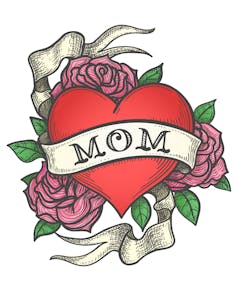
Old school. Shutterstock
There is also a growing sense of professionalism within the industry. While there is no minimum qualification, most tattoo artists in Sydney have a background in art or design and enter the occupation as an apprentice to learn the trade, which is increasingly presented in creative terms or “artistry”.
Newly opened studios have more in common with hairdressing salons (light colours, soft music, bright lights) than with the dark, noisy tattoo parlours of old. Critical techniques around hygiene (sterile disposable needles, single use ink dispensers, surgical gloves) are now routine, underpinned by external regulation. In Sydney, for example, artists are required to obtain a Tattoo Artist License, renewable every three years (based on age, citizenship and often involving a background police check). Studio owners must also gain an operator’s license and failure to adhere to necessary standards and practices of cleanliness and hygiene may mean that a license is revoked. Similar regulations for studios are in operation in the UK.
Together with the growth in tattoo artistry over the last decade, this signifies a greater level of acceptability and “mainstreaming”, with many high streets featuring at least one studio. Force of numbers alone suggests that employers must try to overcome their aversion to tattoos and that this form of body art will increasingly enter the world of work. This raises the possibility that we will in the future see inked skin among more employees, beyond the armed forces, professors and the Metropolitan Police.


