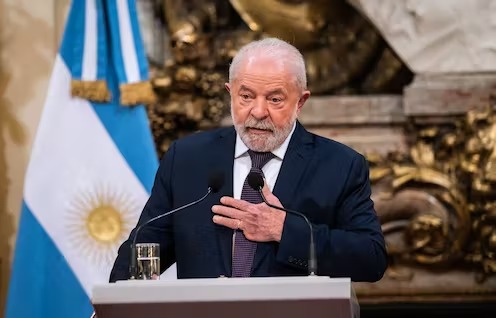
Brazilian President Luiz Inacio Lula da Silva is taking an unusually cautious approach to his re-election campaign ahead of Brazil’s October election, as right-wing Senator Flavio Bolsonaro closes the gap in opinion polls.
Lula currently holds a narrow lead over Bolsonaro, the son of former President Jair Bolsonaro, with recent surveys showing just a 1- to 3-percentage-point difference in a potential second-round contest.
Campaign advisers say concerns about misinformation, artificial intelligence, foreign interference and electoral law violations have contributed to the subdued strategy. Officials at the Planalto presidential palace have reportedly been instructed to carefully review government actions to prevent accusations that public resources are being used to benefit Lula’s campaign.
Ministers have been asked to remove some social media posts, while state television has stopped broadcasting presidential events over concerns about possible election-law violations. Government announcements and public appearances are also receiving additional scrutiny.
Despite those precautions, Lula recently faced criticism after saying he had never met a lobbyist under investigation in a corruption case. Photos of the two together subsequently circulated online. Lula’s campaign said the president frequently poses for photographs with people he does not personally know.
Bolsonaro has faced controversy of his own. A Brazilian magazine reported that he received $1.6 million from former banker Daniel Vorcaro, who is being investigated in connection with a major financial fraud case. Another $24 million payment had previously been disclosed in May.
Lula’s allies are particularly concerned about AI-generated misinformation and what they view as potential U.S. influence in Latin American politics. The U.S. State Department has previously rejected Brazilian government accusations of election interference.
Political fatigue is also shaping the Brazil presidential election. Analysts say years of polarization between Lula and the Bolsonaro movement have reduced voter enthusiasm and public engagement.
Brazil’s electoral court has further limited campaign reach by preventing platforms from recommending candidates’ content to users who do not follow them. Analysts say the restrictions may reinforce political echo chambers while benefiting Lula and Bolsonaro, whose strong polling positions give them little incentive to pursue more aggressive campaign strategies.