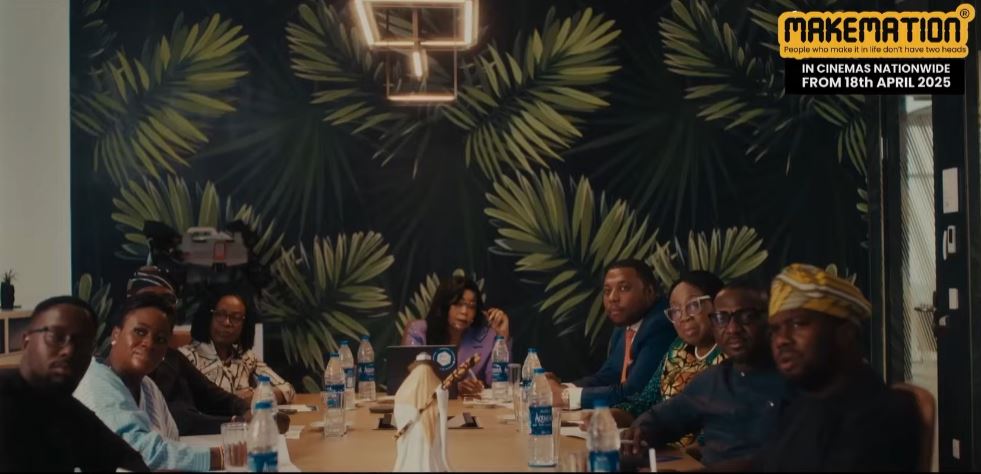
A new feature film, Makemation, is an African coming-of-age story set in a time of artificial intelligence (AI).
Makemation was produced by Nigerian AI-developer-turned-filmmaker Toyosi Akerele-Ogunsiji. As conversations about AI are dominated by external global powers, his film offers a different vantage point: an AI story rooted in African realities.
After a successful run in Nigerian cinemas in 2025, it’s now touring internationally and I attended a screening at the Harvard Center for African Studies. It was followed by a discussion with its producer and economist Ebehi Iyoha, who researches AI in Africa. The evening foregrounded precisely what the film so deftly dramatises: that the future of AI can also be imagined, contested and built on the African continent.
Makemation is about a young girl, Zara, who discovers AI as a tool not just for personal advancement, but for transforming her community. She must navigate poverty, gender expectations and limited access to science, technology, engineering and maths education. In the process, her journey becomes a powerful reflection on youth innovation, digital inclusion and the possibilities of homegrown technology in Africa.
As a scholar of literature and cultural studies, I see Makemation as a vital intervention that challenges the dominance of western techno-narratives. It places AI within local histories of inequality, aspiration and improvisation.
My work also examines popular media as cultural archives through which African futures are imagined and debated. Makemation expands the archive through which we study who gets to imagine and write African futures.
African tech futures
The title of the film is a blending of words that combines “make” and the suffix “–mation” to evoke ideas like automation, transformation and imagination. It captures the film’s central claim: that young Africans are not passive consumers of AI, but active makers of it.
Makemation asks: who gets to shape the AI revolution? Who benefits from it? And what does innovation look like in places where infrastructure is fragile? Where formal employment is scarce, and ingenuity is often born of necessity?
It does not treat Africa as a technological afterthought. Much of the global AI debate remains abstract and heavily mediated by the concerns of major technology companies or the governments of China and the US: existential risk, large language models, automation at scale.
These conversations, while important, often obscure the material realities of communities where access to electricity, stable internet or quality education cannot be taken for granted. In many African cities, largely informal and dynamic, young people are already improvising with technology in ways that challenge narrow definitions of innovation.
Makemation demonstrates this vividly. Informality is not depicted as absence or lack, but as a site of creativity. The protagonist captures this tension when she says, “My father is a welder and my mother sells akara (street food).” She goes on to explain that she believes education and innovation can create opportunities. Lines like this connect the film’s discussion of AI to everyday forms of labour, grounding its ideas in the realities of family, work, and aspiration.
In the discussion after the screening, Akerele-Ogunsiji spoke about the importance of storytelling in shaping technological futures. If narratives about AI continue to centre only a handful of geographies and demographics, they risk entrenching existing inequalities.
Africa’s youth bulge
Africa, according to the UN, is home to one of the youngest populations in the world. This demographic reality has profound implications for AI adoption, labour markets and education systems.
If supported by inclusive policies and meaningful access to digital tools, this film tells us, this generation could shape AI in ways that reflect local priorities rather than imported assumptions.
At the heart of the film lies a set of intertwined questions about access and privilege. Who has the bandwidth, literally and figuratively, to participate in AI development? Who has the confidence to imagine themselves as technologists?
The young protagonist’s journey is not simply about mastering code or winning a competition. It’s about negotiating gender expectations, economic precarity and the psychological barriers that tell many young African girls that technology is not for them.
In this sense, Makemation is as much about social infrastructure as it is about digital infrastructure. Mentorship, community support and visible role models matter. The film does not romanticise hardship. Instead, it shows how structural constraints shape technological possibility.
Makemation works not only because of its idea but also because it is well made. The camera often stays close to the characters, and the soft colours create a reflective mood. The slow editing gives the story time to develop.
Its most important message is to destabilise the idea that meaningful AI conversations happen only in elite spaces. Makemation demonstrates that debates about AI technologies and opportunities that come with them are already unfolding in classrooms, community centres and informal neighbourhoods across Africa.

Tinashe Mushakavanhu does not work for, consult, own shares in or receive funding from any company or organisation that would benefit from this article, and has disclosed no relevant affiliations beyond their academic appointment.