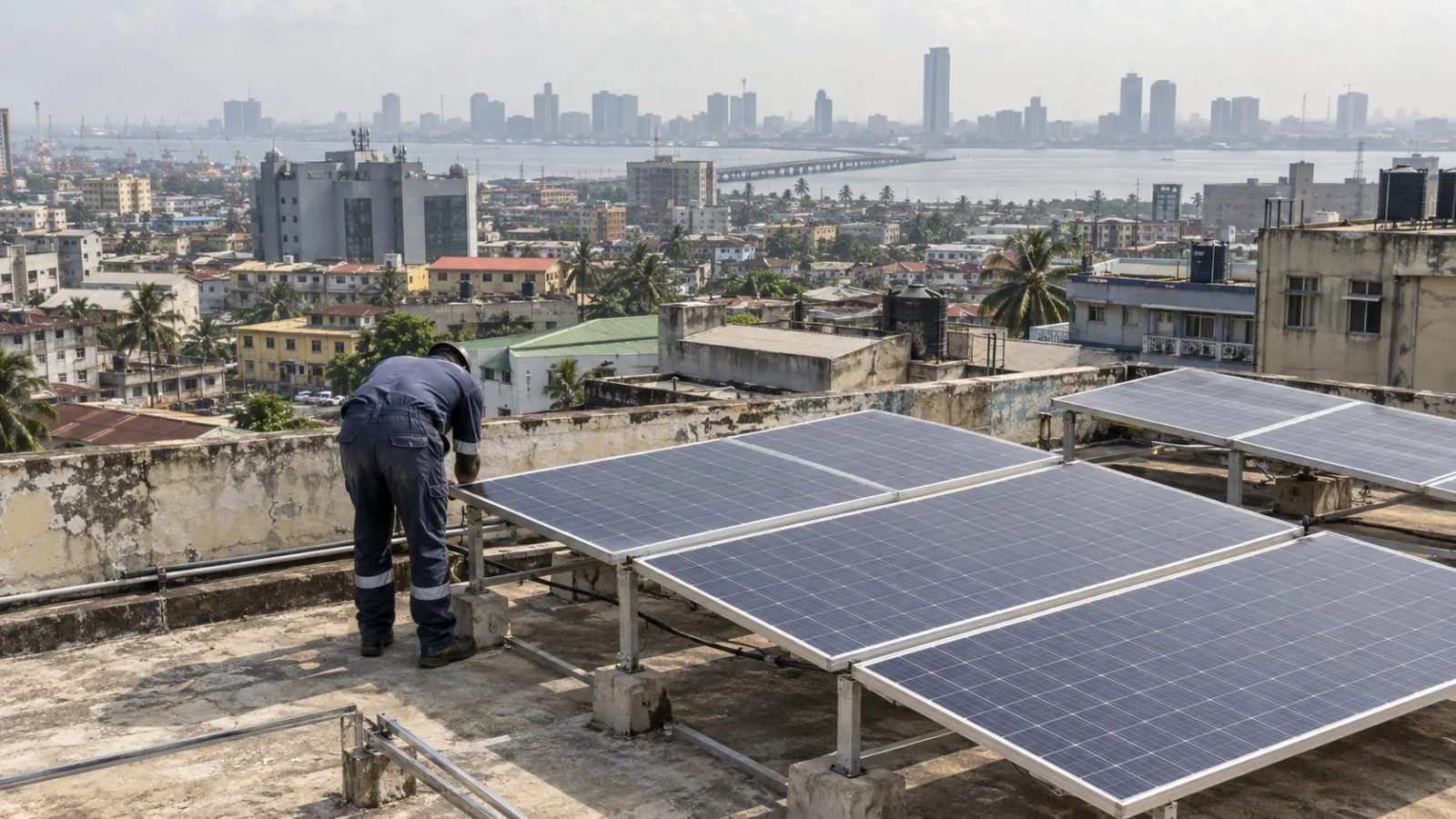
Nigeria logged 370 new solar-company registrations in 2025, nearly seven times the 2019 total, signaling commercial interest but not showing how many firms operate or how much capacity is installed, researchers say.
The figures come from a report by energy research groups Ember and African Tech Futures Lab. The count rose from 56 registrations in 2019, but does not establish how many companies remain active or how much solar power they have installed.
The report estimates that distributed solar — customer-side systems generally used to supply the customer’s own electricity — made up 20 gigawatts of the 26 gigawatts of solar capacity added across Africa from 2023 through 2025. That is about three-quarters of the total. Ember found official national solar-capacity figures for 36 of Africa’s 54 countries, with only 14 countries reporting figures that covered 2025. The researchers say gaps in the data can leave power planners without a full view of electricity demand and generation needs.
Ember identifies unreliable supply, falling equipment prices and electricity costs as drivers of solar adoption across Africa. In Nigeria, the Nigerian Electricity Regulatory Commission (NERC) put a tariff review for higher-service Band A customers into effect on April 1, 2024. The category has a minimum service standard of 20 hours of electricity a day; Bands B through E remained at their earlier rates during that review.
The shift also carries costs, Ember says. It estimates that business self-generation costs two to four times as much as utility-scale capacity on an all-in basis, an Africa-wide comparison rather than a Nigeria-specific measurement. The research groups warn that when large customers buy less grid electricity, utilities lose revenue used to cross-subsidize poorer households. “Policymakers need to start responding to this shift,” said Joel Nana, research director at African Tech Futures Lab.
Ember estimates Nigeria will install 1.7 gigawatts of solar capacity in 2026. The forecast uses Chinese panel export data through June 2026 and assumes an average six-month gap between shipment and installation; it is not a final count of completed projects.