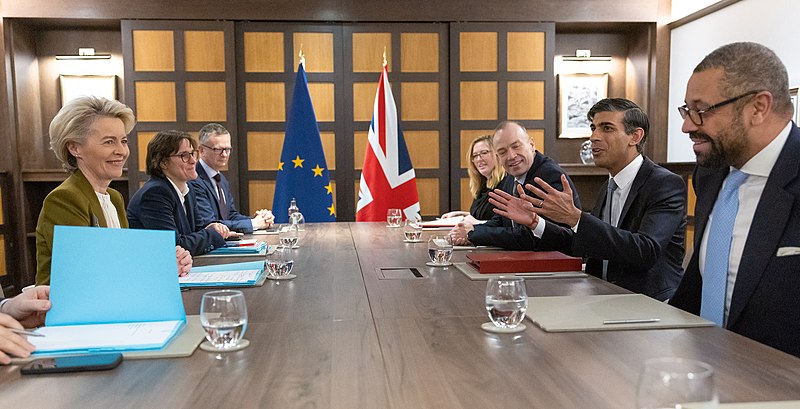
The leader of Northern Ireland’s largest political party has expressed concerns over parts of the new post-Brexit trade deal between the United Kingdom and the European Union. The party’s support for the deal is crucial due to the devolved government in the region.
On Tuesday, Northern Ireland’s Democratic Unionist Party leader Jeffrey Donaldson said in a statement on the party’s website that there were still concerns in key areas in the new deal between the UK and EU to simplify trade rules in the region after the UK left the bloc. This follows the DUP’s announcement last week to undergo a month-long consultation on the new post-Brexit deal known as the Windsor Framework.
“It is my current assessment that there remains key areas of concern which require further clarification, re-working, and change as well as seeing further legal text,” said Donaldson.
Donaldson’s statement follows previous DUP statements that said at the time, the party was ready to engage in the changes and clarifications as needed. The consultation of the DUP is set to report back to the party by the end of March.
A spokesperson for British Prime Minister Rishi Sunak said the government was engaging with the DUP and is open to further discussions and questions the party may have.
“We’ve been clear to the government as the framework sits at the moment, it is insufficient to fully address the concerns that we have,” Donaldson told the BBC in a separate interview. “What we are doing on an ongoing basis is identifying what those concerns are and what the remedy is in law, particularly legislation.”
Donaldson cited the areas of concern, such as the damage done to Northern Ireland’s union with the rest of the UK, the region’s place in the UK’s internal market, the role of EU law, the “green lane” for imports from the UK and the “democratic deficit” around the implementation of EU laws.
On the same day, US President Joe Biden said he accepted the invitation from Sunak to visit Northern Ireland in April to mark the 25th anniversary of the Good Friday Agreement, which largely ended political violence in the region. Biden announced his plans to visit the region during a summit to launch the next phase of the AUKUS submarine agreement between the US, the UK, and Australia.