


 Gold Prices Fall Amid Rate Jitters; Copper Steady as China Stimulus Eyed
  Best Gold Stocks to Buy Now: AABB, GOLD, GDX


 Add as a preferred source on Google
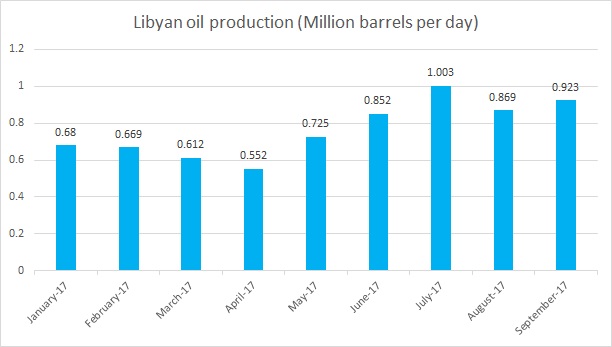
While Nigeria is expected to be pressured to join the OPEC supply reduction initiative by both OPEC members and non-OPEC participating countries like Russia when they meet to discuss the future of the agreement in Vienna on November 30th, Libya is likely to receive exemption once again. When Libya’s oil production crossed a million barrels per day in July, it was expected that it would be asked to join the initiative. However, a militant attack on its biggest oil production pipeline in August reduced Libya’s production by a third and the total production declined to 0.87 million barrels per day in August. OPEC’s latest October report shows that the production didn’t reach the July peak. There was another attack on its biggest Sahara oil field in September.
We at FxWirePro believe that contrary to Nigeria, Libya is expected to find sympathizers both within and outside OPEC. We don’t expect Libya to join the OPEC initiative unless it reaches sustained production of 1.3 million barrels per day. So far in 2017, Libya produced oil at an average of 0.76 million barrels per day, which is 0.6 million barrels less than its four-decade average and 0.8 million barrels lower than its pre-civil war peak.







