
It seems that economists have been too pessimistic on Russia, with drop in oil prices and increased competition from Middle East oil producers and now they are turning to revise their projections.
- The World Bank has raised its GDP growth forecasts for Russia. It lifted its forecast for 2015 to a contraction of 2.7 per cent, up from the contraction of 3.8 per cent it predicted in April. In addition, it has pushed up its growth forecast for 2016 to 0.7 per cent from the decline of 0.3 per cent. World Bank sees Russian recovery to be more prominent in 2017.
Along with that World Bank forecasts oil price to average $58/barrel in 2015 and $63.6/barrel in 2016.
Not oil price alone, but faster drop in inflation has led World Bank to revise its forecast.
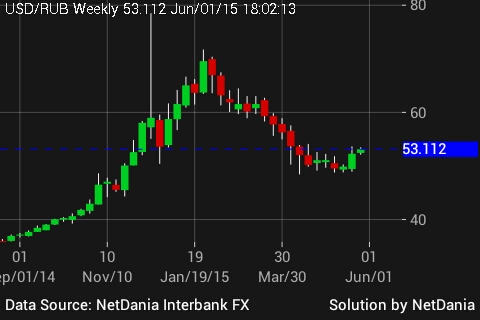
However, drop in Ruble exchange rate while helped taming the inflation, it has also reduced revenues earned from oil exports in local currencies.
Ruble is unmoved by the news, since it is now facing pressure over FIFA arrests, that threatens Russia's hosting of football world cup in 2018.
Ruble is currently trading at 53.2 against dollar.
Russian central bank has some space to reduce rates further, which is hovering at 12.5% but will likely to wait until current situation over FIFA subsides and Ruble stabilizes once more.


