
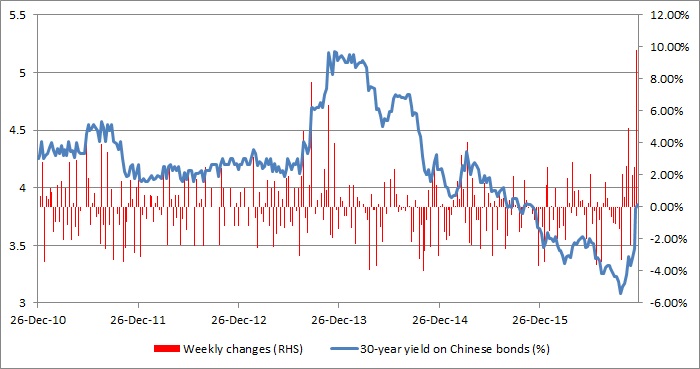
Volatility in the Chinese bond markets has become a contentious issue for the policymakers, who are struggling to contain the rise in yield amid an interest rate hike from the US Federal Reserve that has sparked renewed dollar rally.
In a previous article, we showed, how the recent strength of the dollar and the fear surrounding Chinese corporate debt have distorted the shift in the yield curve, where the shorter end of the curve jumped more than the longer end, and the very longer end jumped more than the 10-year. We suspect that the market is pricing a greater turmoil in the short and the very same reason is causing the volatility too.
This chart shows the 30-year yield on Chinese government bond, along with the weekly changes. Last week, Chinese 30-year yield rose by 9.74 percent. We expect the People’s Bank of China (PBoC) to continue with its market operations to both contain volatility and yields.

