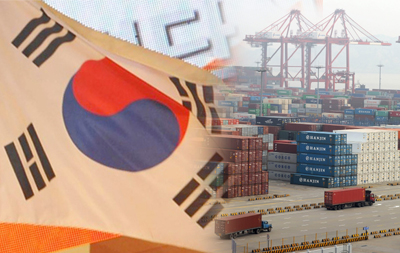
An economic policy body urged South Korea to ease its reliance on major partners due to uncertainties brought by the trade between the US and China and export restrictions from Japan.
The US and China accounted for nearly 40 percent of South Korea's exports last year.
Instead, Korea Institute for International Economic Policy (KIEP) suggested that the country eye more partnerships with developing nations on a long-term perspective.
South Korea aims to conclude the Regional Comprehensive Economic Partnership (RCEP) for creating an economic bloc that would account for a third of the world's gross domestic product by the end of this year.
The RCEP would be composed of South Korea, Japan, Australia, New Zealand, China, and the ASEAN.
There is also a joint feasibility study on an FTA to be undertaken by South Korea and Cambodia.
In 2019, South Korea implemented 16 FTAs that cover 57 trade partners.
South Korea's exports slipped 23.7 percent in May, which is the third consecutive month that it dropped.
In contrast, South Korea's shipments to 52 free-trade agreement (FTA) partners more than doubled from 2004 to 2018, increasing from $170 to US$438.6 billion, according to the KIEP.
During that period, imports from the nations also more than doubled, which jumped from $121.7 billion to $334.6 billion.
The foreign direct investment of the said countries in South Korea also increased from $61.9 billion posted in 2005 to $211.9 billion in 2017, based on the KIEP report.