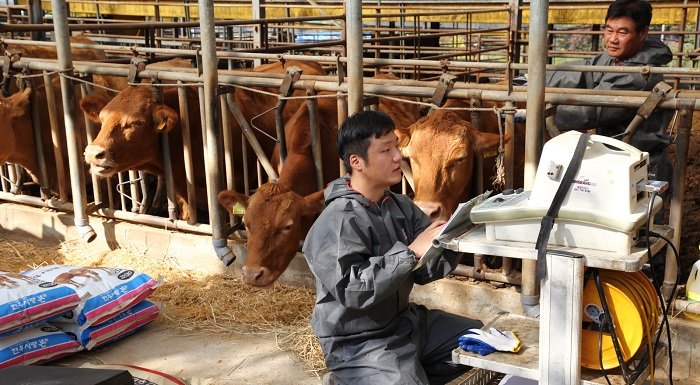
South Korea's Ministry of Agriculture, Food and Rural Affairs will invest about 10 billion won over the next three years to conduct a trial of cow breeding methods aimed at reducing greenhouse gases generated during the process.
The feeding trial program would be for roughly 600 calves at a farm run by the National Agricultural Cooperative Federation in Anseong, Gyeonggi Province, based on the genetic trait, breeding season, and nutritional level.
The length of the cow breeding time has increased over the last 20 years, and farmers have become more reliant on feed grain, making the breeding procedure more expensive.
The fattening cow breeding time was prolonged from around 23 months in 2000 to about 30 months in 2020, increasing excrement and greenhouse gas emissions.
The ministry hopes to build an appropriate breeding model as well as reduce the slaughter age of cows from 30 to 24 months with this program.
If the breeding season is shortened, the number of greenhouse gases produced per cow can be lowered to around 75 percent of what it is now. Furthermore, the cost of feeding a cow can be decreased by roughly 1 million won.