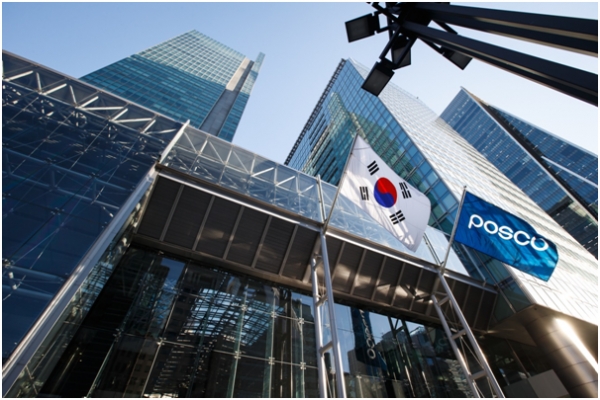
South Korea's Posco Group said it expects to raise its annual sales over 102 trillion won by 2023, 12 trillion won more than that of 2020 while announcing its new midterm plan from 2021 to 2023.
The world’s fifth-largest steelmaker also forecast improved outcomes from its key growth businesses, including hydrogen, liquefied natural gas, food, and battery materials. The company vowed to increase investment in future business opportunities, Hydrogen business, auto parts manufacturing, and the development of core materials for secondary batteries while improving corporate governance.
Posco has established an ESG committee through which it would discuss plans and strategies to reduce environmental damages and industrial accidents and roll out detailed schemes for achieving carbon neutrality by 2050.
To reduce reliance on fossil fuels, Posco aims to boost hydrogen production from the current 7,000 tons, mostly through natural gas and byproducts from its power plants to 5 million metric tons by 2050.
Last week, Posco forged a partnership with research institutions to develop technology for mass-producing hydrogen from ammonia.
Posco has been expanding its business into the hydrogen fuel cell market too, inking a supply deal for fuel cell electric vehicles with Hyundai Motor.
Posco SPS, the company's steel processing unit, will produce 10,000 tons of fuel-cell bipolar plates annually by 2027, enough to manufacture about 245,000 fuel-cell electric vehicles.
Posco will intensify its research and development of secondary battery materials, seeking to establish manufacturing facilities capable of generating 23 trillion won in annual sales and earning a 20 percent global market share by 2030.
Meanwhile, Posco Chemical is boosting its annual cathode production capacity to over 100,000 tons by 2023.
In the field of steel-making, Posco had signed a memorandum of understanding this month to develop a lighter, new material for battery packs of electric vehicles, based on a steel-plastic composite.
The group will also invest around 1 trillion won to renew its manufacturing facilities to improve workplace safety.