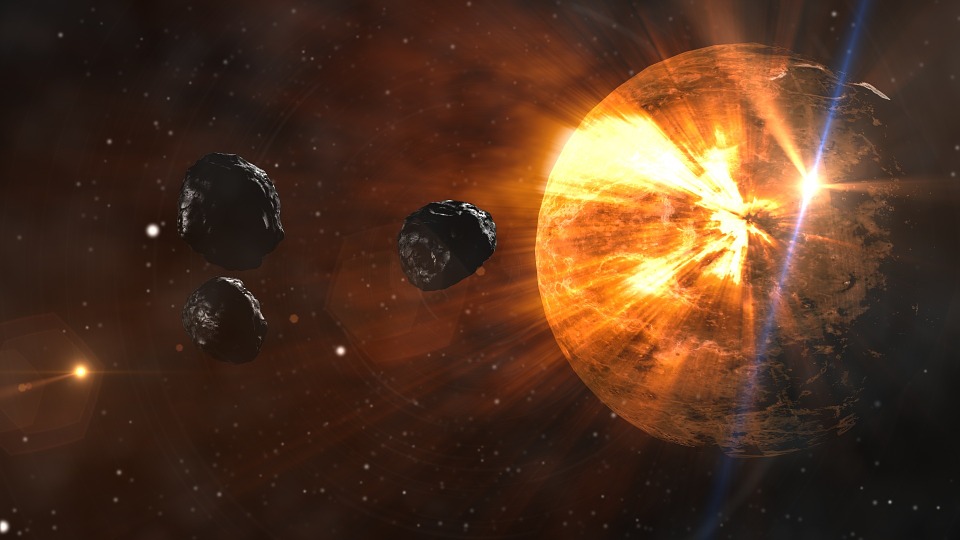
Asteroid threats are among the favorite tropes that Hollywood uses in movies to depict the end of humanity. While the chances of a world-ending space rock hitting the earth might be remote, scientists are particularly concerned with the one they call Bennu. This asteroid is roughly the size of the Empire State building and is apparently poses the biggest threat to Earth. To address the issue, scientists are mulling over the idea of using a nuclear missile.
Anyone who has ever seen any movie feature asteroid threats ever will undoubtedly have heard the arguments against launching nuclear missiles at the space rocks. However, this isn’t exactly what the good people over at NASA had in mind. Rather, they were planning on using the Hypervelocity Asteroid Mitigation Mission for Emergency Response (HAMMER) missile to deflect the asteroid.
HAMMER would essentially bore into the asteroid and either push it off course or create an explosion that would generate enough force to achieve the same goal. It’s worth pointing out that even a difference of a few meters in a change of direction could have a huge effect on how far the asteroid could miss the Earth. Unfortunately, it seems this method is not enough.
According to a new study, sending just one HAMMER rocket at Bennu will not be enough, the International Business Times reports. The rocket is too big and too dense for just one missile to do the job.
On the other hand, sending multiple rockets might just do the trick, provided humans can actually develop rocket technology with enough accuracy and lasting power to make the difference. If Bennu does end up hitting the Earth, it would produce an explosion comparable to 1,450 megatons of TNT. For context, the bombs dropped in Hiroshima and Nagasaki were only equivalent to 20 kilotons of TNT.