Singapore's Oct. 24 air-quality figures put the 24-hour Pollutant Standards Index (PSI) in the Unhealthy range, while CNA tests in two flats found indoor PM2.5 could stay elevated or rise when windows opened.
At 5 a.m. ET (09:00 UTC) Oct. 24, the National Environment Agency (NEA) reported one-hour PM2.5 readings of 33–97 µg/m³, in the Elevated band, and a 24-hour PSI of 108–151, in the Unhealthy range. NEA says one-hour PM2.5 readings help guide immediate activity decisions, while the PSI forecast is intended for planning the next day.
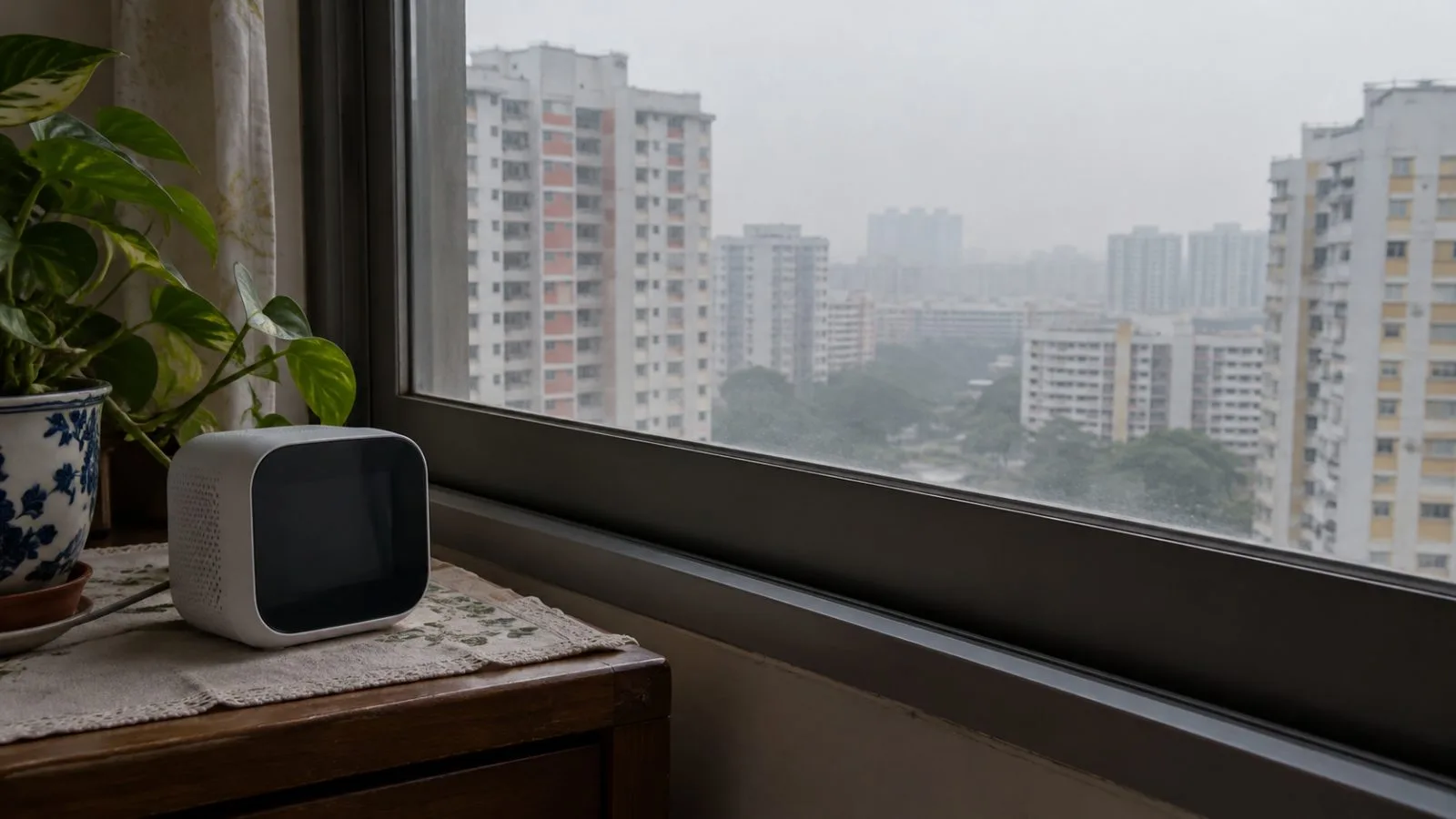
CNA's Talking Point measured 187 µg/m³ indoors in a fifth-floor flat after its windows had been closed for an hour, compared with 169 µg/m³ outside. The resident had opened the windows earlier that morning. Leonard Ng, an assistant professor at Nanyang Technological University, said polluted air may have remained inside after the windows were shut. “If the air quality is poor outside, it’ll be poor inside as well,” Ng said.
In a 15th-floor flat in the same block, CNA recorded 149 µg/m³ after the windows had been closed for an hour. The reading rose to 301 µg/m³ after they were opened as haze worsened. The measurements came from two homes, not a survey of Singapore housing.
CNA also reported separate tests of indoor filtration. In one bedroom, PM2.5 fell from 131.6 to 109.8 µg/m³ after an air conditioner ran for 10 minutes. In a separate living-room test, an air purifier lowered the reading to 40.7 µg/m³ after an hour; the different conditions and durations do not allow a direct comparison. The U.S. Environmental Protection Agency (EPA) advises choosing a portable air cleaner with a clean air delivery rate suited to the room, with higher rates able to serve larger areas.
The World Health Organization (WHO) says particulate matter can reach deep into the lungs and enter the bloodstream, with respiratory and cardiovascular effects. Singapore's Ministry of Health (MOH) advises healthy people to reduce prolonged or strenuous outdoor exertion when the PSI forecast is Unhealthy. It advises older people, pregnant women and children to minimize such exertion, and people with chronic heart or lung disease to avoid it.
At ST Engineering's mask facility, CNA reported that one N95 sample expired in 2017 filtered 99% of test particles, while another expired in 2022 filtered 93%. Those results apply to the samples tested. MOH advises against routine N95 use indoors and says people who must spend several hours outdoors should consider an N95 or equivalent mask when PM2.5 exceeds 250 µg/m³; the mask must fit well to reduce exposure. The U.S. National Institute for Occupational Safety and Health (NIOSH) says respirators past their designated shelf life may no longer meet certification requirements, and storage and component condition matter.
NEA forecast a PSI of 80–130 for Oct. 25, ranging from Moderate to Unhealthy.