
The peak of the cost-of-living crisis may have passed, but millions of families are struggling to buy enough food to feed their children. Experiencing food insecurity can be deeply damaging for children and negatively affects their achievement at school.
My research, alongside other studies, shows that schools are operating their own food banks and providing charitable food aid to families. This shows how the education system – from early years to secondary schools – is increasingly at the front line in responding to child poverty, food insecurity, and destitution.
At the start of the financial crisis in 2008 there were few food banks in the UK. Now they are in towns and cities across the country. In 2010-11, charity the Trussell Trust operated 35 food bank centres. Now, the charity runs over 1400.
Recent research from the charity the Food Foundation estimates that one in five families with children do not have secure access to food.
After almost a decade and a half of Conservative governments, a significant number of schools are running food banks to support families and children.
I interviewed school staff at 25 schools across England, in towns and cities including Bristol, Liverpool and London. I wanted to understand how and why schools are providing charitable food to families.
The message was clear: schools were running food banks because they were faced with growing poverty and families struggling financially. Parents can’t afford to buy food or pay bills, and turn to schools for help. As one staff member I spoke to said:
They don’t have enough food, they don’t eat typically well because they can’t afford it, and that’s no fault of their own.
Teachers talked about the cost of living crisis and changes to the UK’s benefit system – in particular the replacement of a number of previous benefit allowances with universal credit – as reasons the food banks were necessary. Research has suggested that the switch to universal credit is leaving some families worse off. “It’s less than what they’re on before. And we have that period where you swap [systems] where you haven’t got any money,” one teacher said.
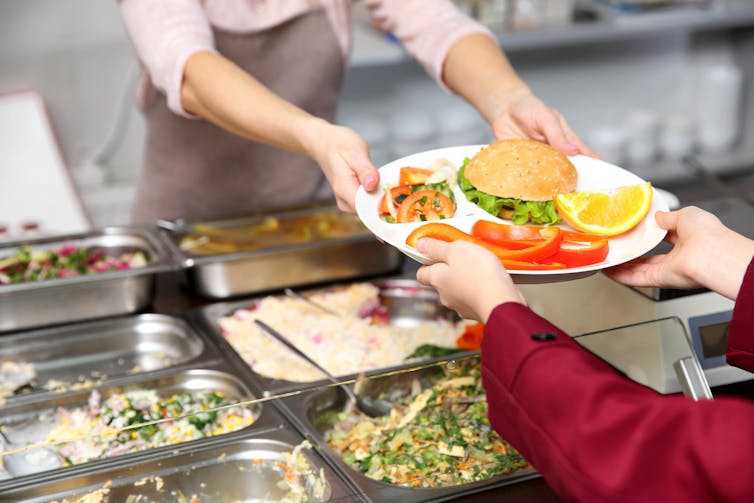
Some of the children whose families used school food banks did not qualify for free school meals. Africa Studio/Shutterstock
Some of the families supported by school food banks did not qualify for free school meals for their children but were still struggling. Commenting on who made use of the foodbank, one teacher said:
Sometimes it’s the ones who have free school meals and sometimes it’s the next lot up that are working families and just have absolutely no money at all and no-one to support them or help them with that because they just miss it.
The growth of food banks in schools shows how schools are often acting as an emergency service. “The government has dismantled public services over the past decade and schools are the last people standing,” Ann Longfield, former children’s commissioner for England, has recently commented.
A growing problem
The latest research I am working on with colleagues throws the situation facing families and schools into even starker relief. We are currently investigating how many school-based food banks there are in England and the sorts of schools they are located in.
Our new research, which has not yet been published in a peer-reviewed journal, suggests that 21% of primary and secondary schools operate some kind of food bank. We estimate that this amounts to over 4,000 school-based food banks across England.
This would mean that there are now more food banks inside schools than the combined total of food banks operated by charities the Trussell Trust – the UK’s largest food bank operator – and the Independent Food Aid Network.
If schools are now systematically supporting families through charitable food aid, they need guidance, support and funding. Families need well-paid and secure work and a social security system that provides people with both dignity and the financial means to buy essentials, which includes being able to buy food and clothes and heat their homes.
It’s worth remembering that the goal of a well-functioning welfare state should be to prevent poverty and destitution in the first place rather than provide relief for them after the fact.
Plans to dramatically reduce child poverty, food insecurity and inequality must be central to all political parties’ election manifestos.