


 Oil Prices Steady as Middle East Crude Flows Recover
  Wall Street Edges Higher as Treasury Yields Retreat
  Oil Prices Hold Steady as Middle East Supply Risks Persist
  Asian Stocks Rise as Chipmakers Rally on Micron Earnings
  G20 Divided Over US Push to Curb Industrial Overcapacity
  Asian Stocks Mixed as Markets Await U.S. Jobs Data
  Nasdaq Futures Jump as Micron Earnings Boost AI Trade
  IMF Says Global Bond Markets Remain Orderly Despite Yield Surge
  Australia Inflation Accelerates to 4% After RBA Rate Hike


 Add as a preferred source on Google
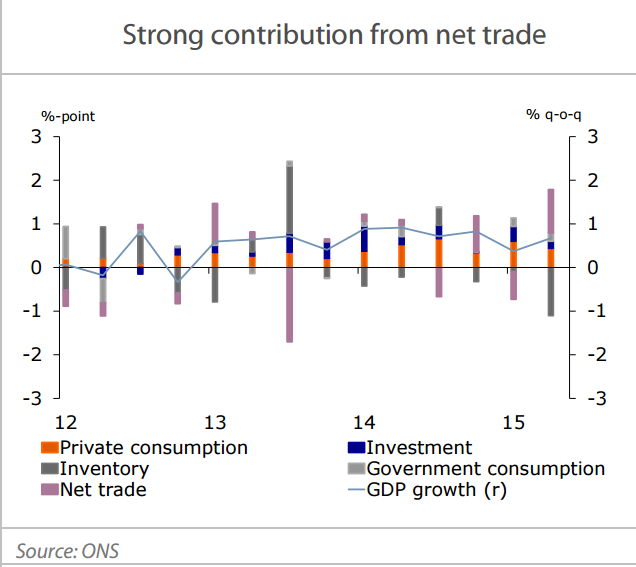
The second estimate of GDP in 2015Q2 confirmed that the British economy expanded by 0.7% q-o-q in the second quarter of 2015. All components, except inventory formation, contributed positively to economic growth. Private consumption increased by 0.7% q-o-q and investment by 0.9%. The latter was mainly driven by business investments, which increased by 2.9% q-o-q. Housing investment, on the other hand, shrunk by 3.5%. But most notable was the 3.9% q-o-q increase of exports. Since imports increased only 0.6% q-o-q, net trade contributed 1% to economic growth. However, this support is not expected to last, since British firms will likely suffer from the strong pound sterling compared to the euro, which will make British products relatively more expensive for the eurozone.
Furthermore, lower productivity growth over the last couple of years -compared to competitors in the United States and Europe- might hurt export performance going forward. On average, nominal wages increased by 2% over the last year, while labour productivity all but stagnated in 2014 (+0.1%). A strong decrease in export orders for July, according to the CBI survey, support the view of a slowdown in export growth in 2016.

- News

- Economy

- Central Banks
- Investing
- Research
- Roundups
- Digital Currency
- Insights
- Technical Analysis
- Technology
- Business
- Law
- Health
- Nature
- Fintech
- Science
- Topic
- Opinions
- ©Econometrics LLC . All Rights Reserved.
UK economic growth in Q2 widely supported
Wednesday, September 2, 2015 10:48 PM UTC
Editor's Picks



- Market Data
Most Popular




