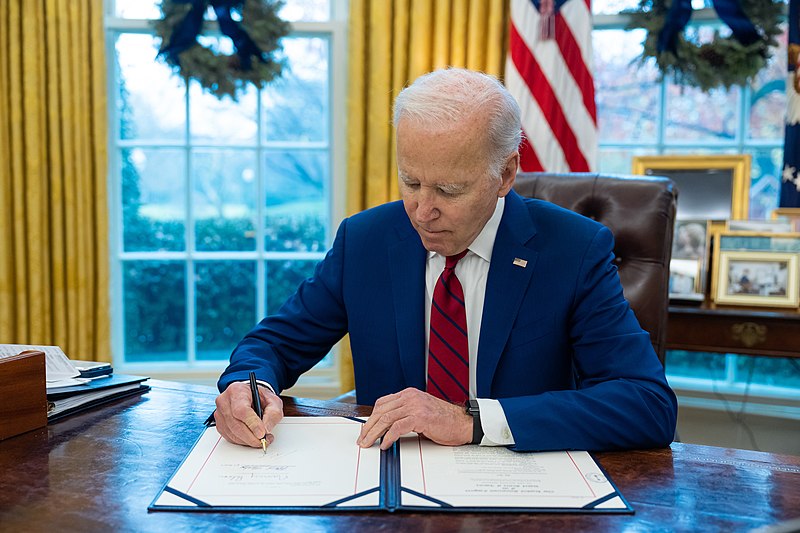
US President Joe Biden has signed the Defense Authorization Act into law passed by Congress last week. However, Biden has expressed concerns over some of the provisions and has urged lawmakers to remove such provisions.
Biden signed the Defense Authorization Act into law Friday last week but raised concerns over some of the provisions in the legislation. Such provisions that Biden expressed concern about may pose a challenge to the Biden administration’s prosecution of detainees in the Guantanamo Bay facility.
“I urge the Congress to eliminate these restrictions as soon as possible,” said Biden in a statement released by the White House. The restrictions the US leader referred to in the bill barred the use of funds to transfer Guantanamo Bay detainees into the United States, effectively shutting down the facility.
The Democratic-led House of Representatives passed the $1.66 trillion government funding legislation, which would provide the military with record funding and ensure continued emergency aid for Ukraine in its war with Russia. The spending bill was passed on mostly party lines, with a vote of 225-201 in the House, following the Senate’s passage of the bill on Thursday last week on a vote of 68-29.
Senate Minority Leader Mitch McConnell was among the 18 Republicans who voted in favor of the bill, while only nine House Republicans voted for the legislation.
The legislation would provide more aid for students with disabilities, funding to protect worker’s rights, more job-training resources, more affordable housing for families, veterans, and those fleeing from domestic violence.
The bill would provide the Pentagon with a record $858 billion budget, an increase from $740 billion in 2021. Lawmakers also included a provision to ban the Chinese-owned video app Tiktok on federal government devices.
An estimated $800 billion would be provided for non-military programs, $68 billion more than the amount in the 2022 fiscal year. Ukraine would also receive $44 billion in aid amidst Ukrainian President Volodymyr Zelenskyy’s visit to Washington last week, as well as $27 billion for victims of natural calamities, increased funding for those struggling with drug addiction, and more funding to assist infrastructure projects coming from the Bipartisan Infrastructure Law that was signed in 2021.