
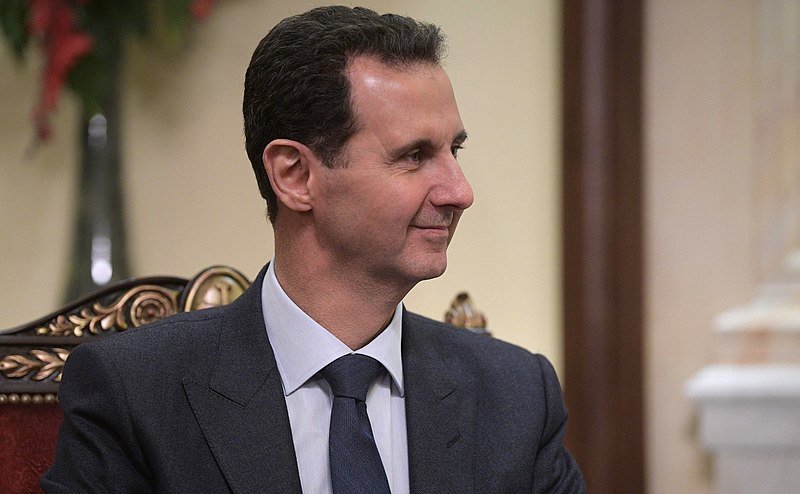
A bipartisan group of lawmakers in the United States introduced legislation this week that would prevent the US government from recognizing Bashar al-Assad as the Syrian President. The legislation would also boost Washington’s ability to impose sanctions, serving as a warning to countries to normalize relations with Assad.
A bipartisan group of lawmakers led by Republican Reps. Joe Wilson, Michael McCaul, and French Hill and Democratic Rep. Brendan Boyle on Thursday introduced a bill that would prevent the government from recognizing Assad as the Syrian President. The legislation, seen by Reuters, would also prevent the government from recognizing or normalizing relations with any Syrian government under Assad, who is currently sanctioned by Washington. The bill would also expand the Caesar Act, which already imposed a round of sanctions on Syria in 2020.
The legislation follows the recent move by Arab states in recent years to move ahead with relations with Assad over the weekend by allowing Syria back into the Arab League even as the West upholds its sanctions on Assad for the years of civil war.
Saudi Arabia, Qatar, and other Arab nations have long supported anti-Assad rebels, but the Syrian army, which is backed by Iran, Russia, and other paramilitary groups, has gained most of the country. The earthquakes that happened in Syria and Turkey in February this year have also added to normalizing relations with Syria.
“Countries choosing to normalize with the unrepentant mass murderer and drug trafficker Bashar al-Assad are headed down the wrong path,” said Wilson, who chairs the House panel for the Middle East, North Africa, and Central Asia in a statement.
A senior congressional aide who participated in the drafting of the bill told Reuters that the legislation serves as a warning to Arab countries and Turkey that they may face consequences should they engage with Assad.
Meanwhile, top officials from the US and China have agreed to maintain lines of communication after eight hours of discussions in Vienna. White House National Security Adviser Jake Sullivan and his Chinese counterpart Wang Yi met in Vienna for two days on Wednesday and Thursday, with both sides describing the meeting as “candid, substantive, and constructive.”
Photo by Kremlin.ru/Wikimedia Commons(CC by 2.0)


_23.jpg)