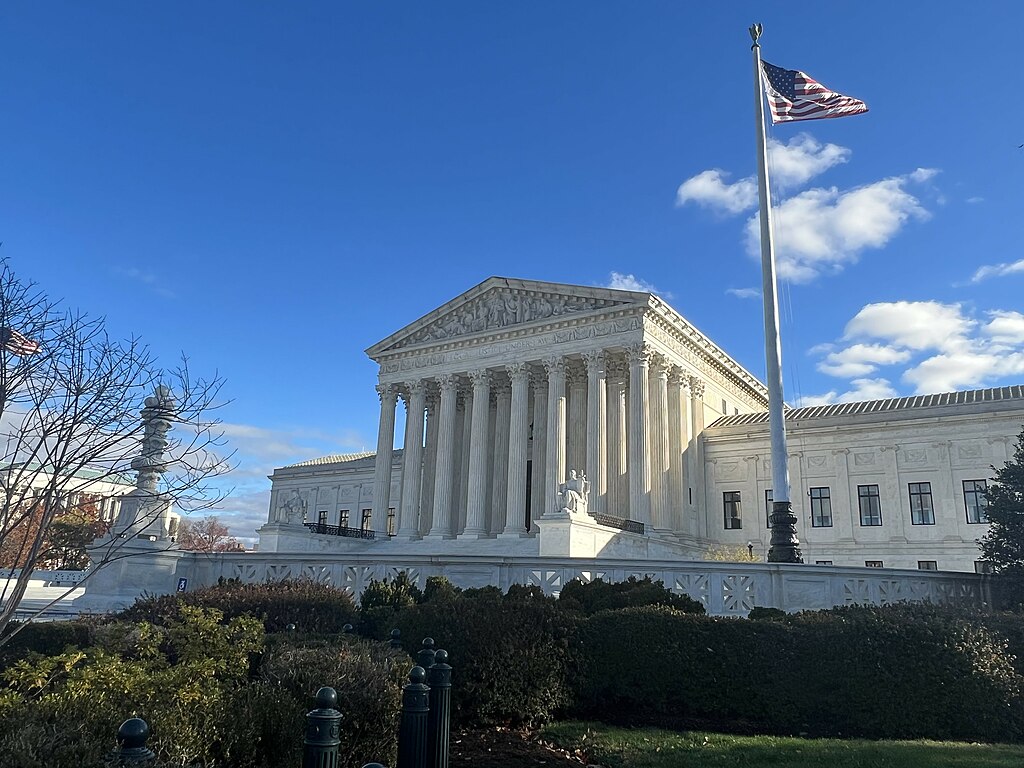
The U.S. Supreme Court has cleared the way for Alabama to implement a Republican-backed congressional map for the 2026 midterm elections, a decision that could strengthen GOP efforts to maintain control of Congress. The ruling temporarily overturns a lower court order that had blocked the map, which is expected to reshape a congressional district currently represented by a Black Democratic lawmaker.
In an unsigned decision issued by the court’s conservative majority, the justices indicated that Alabama is likely to prevail in ongoing legal challenges brought by Black voters and civil rights organizations. The challengers argue that the map reduces the political influence of Black voters and violates both the Voting Rights Act and constitutional equal protection guarantees.
The dispute centers on Alabama’s seven congressional districts. Under the proposed map, the number of districts where Black voters hold a majority or near-majority would decrease from two to one, despite Black residents making up roughly one-quarter of the state’s population. Critics claim the change weakens minority representation and disproportionately benefits Republican candidates.
The Supreme Court’s decision follows a broader wave of redistricting battles across the southern United States. Several Republican-led states have moved to redraw electoral boundaries after a recent Supreme Court ruling significantly narrowed protections under the Voting Rights Act. Similar redistricting efforts have emerged in states such as Tennessee and Louisiana, where district boundaries affecting Black voters have also been revised.
Liberal justices strongly opposed the ruling, arguing that it undermines democratic principles and voter protections. Civil rights advocates, including attorneys representing Black voters, condemned the decision and pledged to continue fighting for fair representation in Alabama.
Meanwhile, Alabama officials welcomed the ruling, describing it as a victory for state authority and lawful redistricting. State leaders argued that elected representatives, rather than federal judges, should have primary responsibility for drawing congressional maps.
The Alabama congressional redistricting case remains part of a larger national debate over voting rights, election law, and political representation. With control of the U.S. House and Senate at stake in the 2026 midterm elections, the outcome of these redistricting disputes could have significant political consequences across the country.