
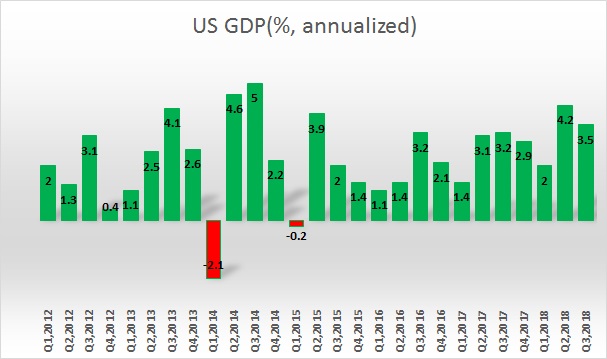
The United States economy is currently in a solid expansion state and for the first time since the 2008/09 ‘Great Recession,’ the U.S. is close to expanding at its long-term growth rate of 3.25 percent. While the uncertainties surrounding the U.S. mid-term election, President Trump’s Iran policies, and trade tension led to a loss of trillions of dollars in the stock market in October, hard data suggest that the economy remains well into an expansionary phase.
In October, the U.S. benchmark stock index, S&P 500 declined sharply from its high of about 8 percent, pushing the index (SPX500) from 2940 to 2700 area, but at the same time job numbers continued to point to solid expansion.
According to data from ADP, the U.S. economy added 227,000 new jobs in October, with 38,000 jobs being created in the goods-producing sectors. The GDP estimate also points to expansion. According to the latest reading, Atlanta Fed’s ‘GDP Now’ model is forecasting a 3 percent growth in the final quarter of the year, revised up from 2.6 percent. The U.S. economy has growth 2 percent in the first quarter of 2018, 4.2 percent in the second, and by 3.5 percent in the third quarter of this year.

