


 Australia Consumer Confidence Plunges as RBA Rate Hike Hits Households
  Yen in Focus as BOJ, Fed Rate Hikes Reshape Currency Markets
  BOJ Set for 25-Basis-Point Rate Hike as Yen Weakness Fuels Inflation
  BlackRock’s Rick Rieder Favors Bonds Over Stocks as Treasury Yields Surge
  Fed Unveils Stablecoin Rules Under GENIUS Act
  Best Gold Stocks to Buy Now: AABB, GOLD, GDX


 Add as a preferred source on Google
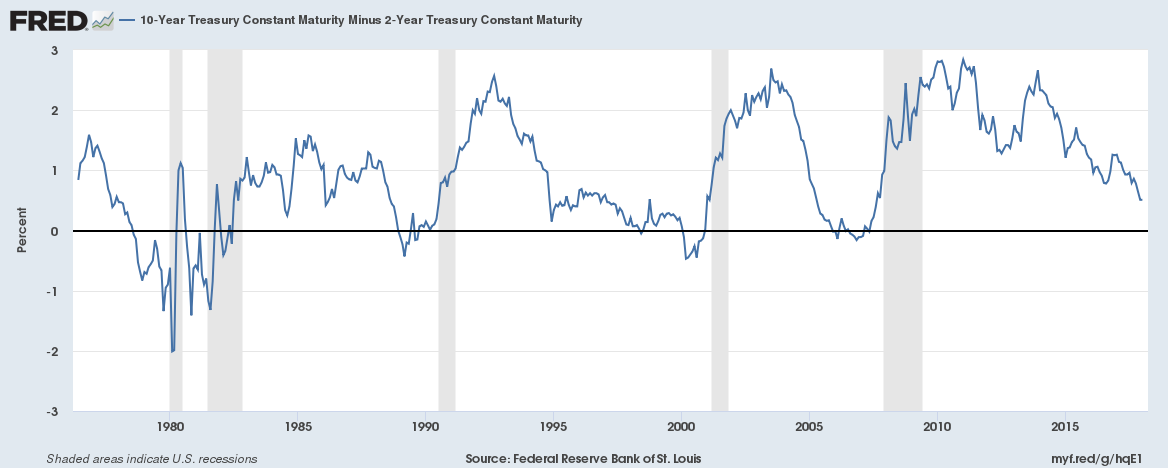
Since December 2015, the U.S. Federal Reserve has hiked interest rates five times; three times in 2017 alone, which has pushed the short-term interest rates higher. However, the increase of the U.S. Federal funds rate as well as the short-term interest rates was not met with a similar increase in the long-term rates, which increases the risk of yield curve inversion.
The above chart shows the difference between U.S. long-term rate (10-year) and short-term rate (2-year). The chart shows that the premium has fallen to just 51 basis points, which is the lowest level in more than a decade.
This is of high importance since the spread is widely accepted as one of the most reliable indicators of a coming recession. Every yield curve inversion was followed by a recession.
The U.S. Federal Reserve has announced plans for three more rate hikes in 2018 and if the long-term rates don’t start rising, such an increase would surely invert the yield curve.
Recently, Atlanta Fed President Raphael W. Bostic expressed similar worries.







