Ahead of RBNZ’s monetary policy meeting that is scheduled next week, the market pricing for a November OCR cut has been stable during the past two weeks at around 80% (currently 86%).
Q3 CPI data was unsurprising to RBNZ forecasts, although it did surprise a number of analysts who expected something lower.
The markets have consistently priced in a greater than 50% chance of a November cut since Assistant Governor McDermott’s speech in September reminding all that the “promised” cut remains in the pipeline.
So what could spook them from cutting? A sharp rise in inflation expectations on 2 Nov (unlikely, given CPI is running at only 0.2%/yr), or a plunge in the NZD, come to mind. We continue to expect a cut on 10 Nov, followed by a lengthy pause.
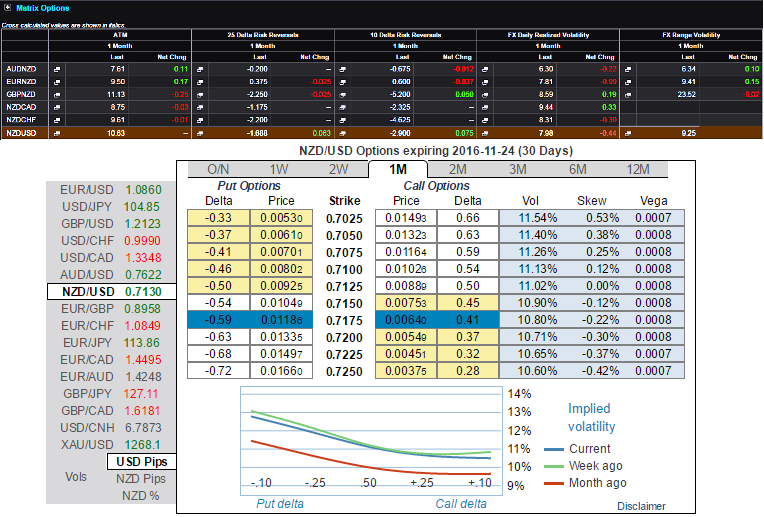
Consequently, the participants in NZD OTC market are getting active, 1m IVs are screaming off over 11.02% and positive skew is observed in OTM put strikes.
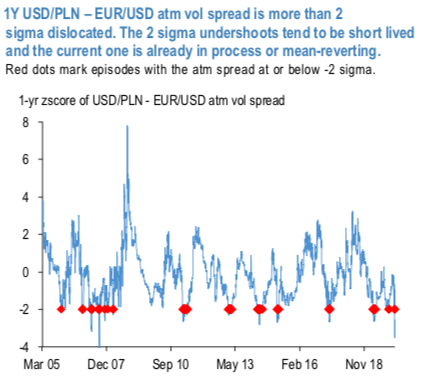
Implied volatility is elevated compared to realized volatility (see above nutshell), suggesting a structure selling it.
The downside skew is not sufficiently elevated to finance a put via low strikes (a put spread-like structure), but the negative skew is enough to obtain an attractive discount via a downside knock-out. Such a barrier is appropriate for trading moderate NZD/USD downside.