


 Baidu Approves $5 Billion Share Buyback and Plans First-Ever Dividend in 2026
  Toyota’s Surprise CEO Change Signals Strategic Shift Amid Global Auto Turmoil
  Reliance Industries Surges on Strong Quarterly Profit, Retail Recovery
  European Stocks Rally on Chinese Growth and Mining Merger Speculation
  Insignia Financial Shares Hit 3-Year High Amid Bain and CC Capital Bidding War
  Tencent Shares Slide After WeChat Restricts YuanBao AI Promotional Links
  U.S. Banks Report Strong Q4 Profits Amid Investment Banking Surge
  U.S. Condemns China's Dominance in Global Shipbuilding and Maritime Sectors
  Why the Middle East is being left behind by global climate finance plans
  Missouri Judge Dismisses Lawsuit Challenging Starbucks’ Diversity and Inclusion Policies
  Once Upon a Farm Raises Nearly $198 Million in IPO, Valued at Over $724 Million



The financial sector is among the world’s most heavily regulated industries – and for good reason. Financial rules, which force banks to hold capital in reserve when making riskier investments, are designed to prevent financial crises. Other financial regulations, such as accounting rules, aim to provide investors with a credible valuation of their financial assets.
However, new research I conducted with my colleagues shows that some of these rules may have unintended consequences for the low-carbon transition.
Building the renewable power sources that will replace fossil fuels will require a lot of money. Much of this will come from banks, among other investors. But some financial regulations affect a bank’s behaviour and lending choices.
By analysing global accounting regulations using data on European banks, our team of researchers identified a structural bias in financial models which are required to assess and report risk.
We found that these models rely on historical information about the creditworthiness of firms to assess the risk of various investments. Alarmingly, they tend to judge carbon-intensive assets as less risky than lower carbon ones.
Decarbonising the world by 2050 could save £12 trillion (US$15 trillion) and prevent the worst effects of global warming. Any barriers to this transition should be removed, including unintended advantages given to fossil fuels and other high-carbon projects by financial regulations.
Low carbon v high carbon risk
We investigated whether models for assessing financial risk are inhibiting the transition from high-carbon economic activities, using data from the European Banking Authority (EBA). We focused on the International Financial Reporting Standard accounting rules and their influence on which companies and sectors banks decide to lend to.
Risk assessments performed by banks on their investments directly affect their profitability. This in turn creates incentives for banks to lend to some activities over others. Our analysis showed that the average estimate of risk among EU banks for high-carbon sectors of the economy was 1.8%, compared with 3.4% for low-carbon sectors (calculated as euros a bank expects to lose with each unit of lending).

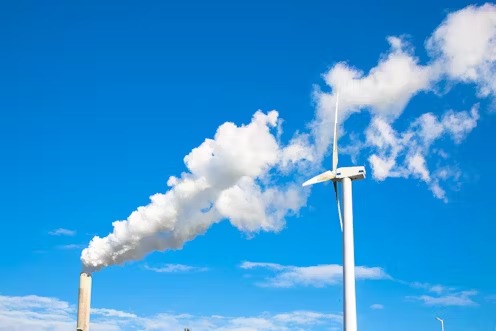
Financial models may overestimate the risk of low-carbon investments by relying on historical trends. William Potter/Shutterstock
One of the largest contributors to the cost of generating renewable energy is the upfront cost of raising investment. Banks tend to lumber riskier investments with higher interest rates, and so these rules could make it more expensive to finance the construction of wind and solar farms.
Conversely, by estimating high-carbon activities as low-risk, these models may discourage banks and other financial institutions from shedding their high-carbon assets and financing the green transition.
Backward-looking models
Financial models may overestimate the risk of low-carbon investments by relying on historical trends that may no longer hold in the future, especially as renewable energy becomes cheaper to generate. This issue probably extends beyond the accounting rules. For example, capital requirement regulations use similar models and shape economic incentives and the behaviour of financial institutions.
Without objective measures of financial risk, it’s hard to replace those estimates that are based on historical observations. One solution may be ensuring risk assessments use climate modelling scenarios to project the risk of high-carbon investments.
Global policymakers are now having to face up to the challenge of meeting their carbon neutrality pledges, but our research suggests that the tools, models and regulations they use are not up to the task.













