


 Dollar Near Two-Week High as Stock Rout, AI Concerns and Global Events Drive Market Volatility
  Bank of Japan Signals Readiness for Near-Term Rate Hike as Inflation Nears Target
  Japanese Pharmaceutical Stocks Slide as TrumpRx.gov Launch Sparks Market Concerns
  Australian Household Spending Dips in December as RBA Tightens Policy
  India–U.S. Interim Trade Pact Cuts Auto Tariffs but Leaves Tesla Out
  Trump Lifts 25% Tariff on Indian Goods in Strategic U.S.–India Trade and Energy Deal
  UK Starting Salaries See Strongest Growth in 18 Months as Hiring Sentiment Improves
  Yen Slides as Japan Election Boosts Fiscal Stimulus Expectations
  U.S. Stock Futures Rise as Markets Brace for Jobs and Inflation Data
  Oil Prices Slip as U.S.-Iran Talks Ease Middle East Tensions
  Trump’s Inflation Claims Clash With Voters’ Cost-of-Living Reality
  Vietnam’s Trade Surplus With US Jumps as Exports Surge and China Imports Hit Record
  Trump Signs Executive Order Threatening 25% Tariffs on Countries Trading With Iran
  Gold and Silver Prices Slide as Dollar Strength and Easing Tensions Weigh on Metals
  Japan Economy Poised for Q4 2025 Growth as Investment and Consumption Hold Firm
  Russian Stocks End Mixed as MOEX Index Closes Flat Amid Commodity Strength



Australia’s three-decade run of near continuous economic growth is set to end, with treasury warning of a hit to growth of “at least” 0.5% in the first quarter of this year, potentially followed by a “prolonged downturn”.
If it came to pass, treasury’s preliminary assessment would most likley mean economic growth vanished and went backwards for several quarters, producing what is commonly known as a “technical recession” – two quarters or more in which economic activity shrank.
Providing the assessment to a Senate estimates committee on Thursday morning, treasury secretary Steven Kennedy said the COVID-19 coronavirus would take “at least half a percentage point” from economic growth during the current March quarter and more beyond that.
In recent quarters economic growth has been about half a percentage point.
Quarterly GDP growth
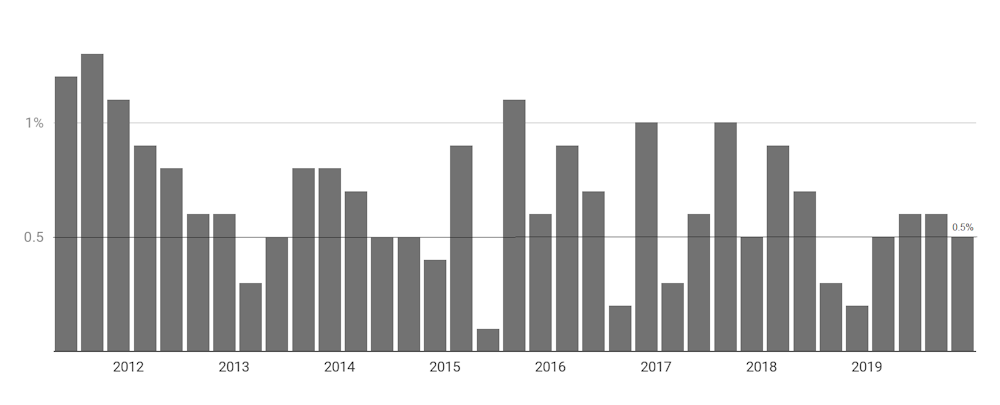
Treasury’s preliminary estimate of a hit of at least half a per cent took into account only the direct impacts of the virus on tourism and education, and some exchange rate effects.
It did not take into account broader economic effects or the impact of the coronavirus on supply chains.
The half a percentage point hit to growth would come on top of a hit of 0.2% from the summer bushfires, most of which would be felt in the March quarter.
Dr Kennedy, a former nurse who retrained as an economist, stressed that the impact of the bushfires would extend well beyond the immediate hit to economic growth.
“Evidence from past episodes suggest bushfires can lead to long-lasting physical and mental health effects and destroy cultural heritage,” he said.
“Research by the University of Melbourne after the Black Saturday bushfires in 2009 found mental health problems continued for three to four years.”
The bushfires made clear the increased probability of such events in a world of climate change.
“The CSIRO predicts climate change will make bushfires more likely, as fire weather patterns worsen as a result of an increase in weather patterns with hot and dry winds and fuel becoming drier.”
Deeper, wider and longer lasting than SARS
As on Tuesday there had been 91,868 confirmed COVID-19 cases worldwide and 3,131 deaths, most in China. COVID-19 had spread to 77 countries.
When the virus first emerged in China in December, the treasury saw it through the lens of the 2002-04 Severe Acute Respiratory Syndrome (SARS) pandemic.
It was now clear COVID-19 would be different.
The impact of SARS took on a V shape, a relatively contained reduction in activity, mostly in Asia, followed by a quick bounce back.
The economic impact of COVID-19 is likely to be deeper, wider and longer when compared with SARS.
It will create more risk of a prolonged downturn, and fiscal support will be needed to accelerate the recovery of the economy, especially once the health and health management effects of COVID-19 begin to fade.
The first phase of the economic support package to be delivered next week would target assistance to the businesses and sectors most affected in order to keep people in jobs.
After that, support for aggregate demand (overall spending) would become more important.
“A very substantial part of the impact is actually confidence among consumers and the business sector because of the uncertainty,” Dr Kennedy said.
“Frankly, effective health management will be very important. The economy is actually quite solid. One of the key things will be to to explain to the community how well placed the economy is to manage such a short-term shock.”
The shock would last for some time but the economy would “recover on the other side”.
Keeping workers employed be very important.













