


 Baidu Approves $5 Billion Share Buyback and Plans First-Ever Dividend in 2026
  Nvidia, ByteDance, and the U.S.-China AI Chip Standoff Over H200 Exports
  AMD Shares Slide Despite Earnings Beat as Cautious Revenue Outlook Weighs on Stock
  SpaceX Seeks FCC Approval for Massive Solar-Powered Satellite Network to Support AI Data Centers
  Amazon Stock Rebounds After Earnings as $200B Capex Plan Sparks AI Spending Debate
  Global PC Makers Eye Chinese Memory Chip Suppliers Amid Ongoing Supply Crunch
  Nintendo Shares Slide After Earnings Miss Raises Switch 2 Margin Concerns
  Nvidia CEO Jensen Huang Says AI Investment Boom Is Just Beginning as NVDA Shares Surge
  Oracle Plans $45–$50 Billion Funding Push in 2026 to Expand Cloud and AI Infrastructure
  SoftBank and Intel Partner to Develop Next-Generation Memory Chips for AI Data Centers
  Nvidia Nears $20 Billion OpenAI Investment as AI Funding Race Intensifies
  TSMC Eyes 3nm Chip Production in Japan with $17 Billion Kumamoto Investment
  OpenAI Expands Enterprise AI Strategy With Major Hiring Push Ahead of New Business Offering
  SpaceX Pivots Toward Moon City as Musk Reframes Long-Term Space Vision
  Jensen Huang Urges Taiwan Suppliers to Boost AI Chip Production Amid Surging Demand
  Palantir Stock Jumps After Strong Q4 Earnings Beat and Upbeat 2026 Revenue Forecast


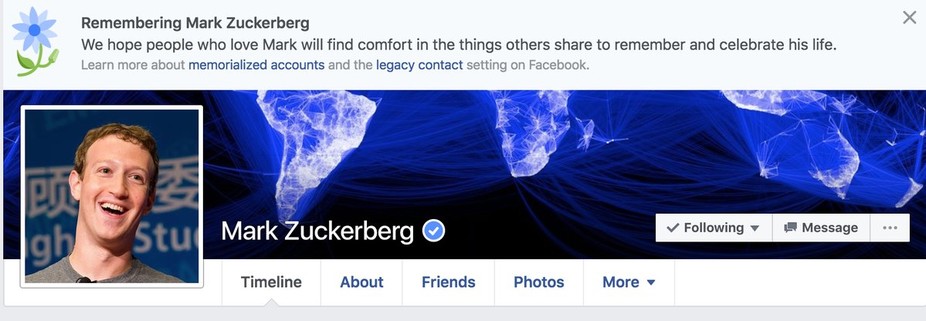

The accidental “death” of Facebook founder Mark Zuckerberg and millions of other Facebook users is a timely reminder of what happens to our online content once we do pass away.
Earlier this month, Zuckerberg’s Facebook profile displayed a banner which read: “We hope the people who love Mark will find comfort in the things others share to remember and celebrate his life.” Similar banners populated profiles across the social network.
After a few hours of users finding family members, friends and themselves(!) unexpectedly declared dead, Facebook realised its widespread error. It resurrected those effected, and shelved the offending posthumous pronouncements.
For many of the 1.8-billion users of the popular social media platform, it was a powerful reminder that Facebook is an increasingly vast digital graveyard.
It’s also a reminder for all social media users to consider how they want their profiles, presences and photos managed after they pass away.
The legal uncertainty of digital assets
Your material goods are usually dealt with by an executor after you pass away.
But what about your digital assets – media profiles, photos, videos, messages and other media? Most national laws do not specifically address digital material.
As most social networks and online platforms are headquartered in the US, they tend to have “terms of use” which fiercely protect the rights of individual users, even after they have died.
Requests to access the accounts of deceased loved ones, even by their executors, are routinely denied on privacy grounds.
While most social networks, including Facebook, explicitly state you cannot let another person know or log in with your password, for a time leaving a list of your passwords for your executor seemed the only easy way to allow someone to clean up and curate your digital presence after death.
Five years ago, as the question of death on social media started to gain interest, this legal uncertainty led to an explosion of startups and services that offered solutions from storing passwords for loved ones, to leaving messages and material to be sent posthumously.
But as with so many startups, many of these services have stagnated or disappeared altogether.
Dealing with death
Public tussles with grieving parents and loved ones over access to deceased accounts have led most big social media platforms to develop their own processes for dealing with digital death.
Facebook now allows users to designate a “legacy contact” who, after your death, can change certain elements of a memorialised account. This includes managing new friend requests, changing profile pictures and pinning a notification post about your death.
But neither a legacy contact, nor anyone else, can delete older material from your profile. That remains visible forever to whoever could see it before you die.
The only other option is to leave specific instructions for your legacy contact to delete your profile in its entirety.
Instagram, owned by Facebook, allows family members to request deletion or (by default) locks the account into a memorialised state. This respects existing privacy settings and prevents anyone logging into that account or changing it in the future.
Twitter will allow verified family members to request the deletion of a deceased person’s account. It will never allow anyone to access it posthumously.
LinkedIn is very similar to Twitter and also allows family members to request the deletion of an account.
Google’s approach to death is decidedly more complicated, with most posthumous options being managed by the not very well known Google Inactive Account Manager.
This tool allows a Google user assign the data from specific Google tools (such as Gmail, YouTube and Google Photos) to either be deleted or sent to a specific contact person after a specified period of “inactivity”.
The minimum period of inactivity that a user can assign is three months, with a warning one month before the specified actions take place.
But as anyone who has ever managed an estate would know, three months is an absurdly long time to wait to access important information, including essential documents that might be stored in Gmail or Google Drive.
If, like most people, the user did not have the Inactive Account Manager turned on, Google requires a court order issued in the United States before it will consider any other requests for data or deletion of a deceased person’s account.
Planning for your digital death
The advice (above) is for just a few of the more popular social media platforms. There are many more online places where people will have accounts and profiles that may also need to be dealt with after a person’s death.
Currently, the laws in Australia and globally have not kept pace with the rapid digitisation of assets, media and identities.
Just as it’s very difficult to legally pass on a Kindle library or iTunes music collection, the question of what happens to digital assets on social media is unclear to most people.
As platforms make tools available, it is important to take note and activate these where they meet (even partially) user needs.
Equally, wills and estates should have specific instructions about how digital material – photos, videos, messages, posts and memories – should ideally be managed.
With any luck the law will catch up by the time these wills get read.
 Tama Leaver receives funding from the Australian Research Council.
This article was originally published on The Conversation. Read the original article.













