China Extends Gold Buying Streak as Reserves Surge Despite Volatile Prices
  South Africa Eyes ECB Repo Lines as Inflation Eases and Rate Cuts Loom
  Yen Slides as Japan Election Boosts Fiscal Stimulus Expectations
  India–U.S. Interim Trade Pact Cuts Auto Tariffs but Leaves Tesla Out
  Indian Refiners Scale Back Russian Oil Imports as U.S.-India Trade Deal Advances
  Japan Economy Poised for Q4 2025 Growth as Investment and Consumption Hold Firm
  Trump Lifts 25% Tariff on Indian Goods in Strategic U.S.–India Trade and Energy Deal
  UK Starting Salaries See Strongest Growth in 18 Months as Hiring Sentiment Improves
  Trump Signs Executive Order Threatening 25% Tariffs on Countries Trading With Iran
  Nikkei 225 Hits Record High Above 56,000 After Japan Election Boosts Market Confidence
  Japanese Pharmaceutical Stocks Slide as TrumpRx.gov Launch Sparks Market Concerns
  Asian Stocks Slip as Tech Rout Deepens, Japan Steadies Ahead of Election
  U.S. Stock Futures Rise as Markets Brace for Jobs and Inflation Data
  RBI Holds Repo Rate at 5.25% as India’s Growth Outlook Strengthens After U.S. Trade Deal
  Oil Prices Slip as U.S.-Iran Talks Ease Middle East Tensions
  Russian Stocks End Mixed as MOEX Index Closes Flat Amid Commodity Strength




The decision by credit ratings agency Moody’s to cut the UK’s sovereign credit rating has been a gift to the government’s critics. The agency downgraded the UK from Aa3 to Aa2 on the rationale that its heavy reliance on face-face services would mean that economic growth would be worse than expected because of the coronavirus pandemic.
Moody’s also cited the likelihood of either no Brexit trade deal or a narrow deal, and said the UK is going through the worst “peak to trough contraction” in the G20. It added that the quality of UK legislative and executive institutions, though still high, has “diminished in recent years”.
The downgrade puts the UK on the same credit rating as Belgium, the Czech Republic, Qatar and Hong Kong – three notches below Aaa nations like the US, Germany, Australia and Norway. The other leading agencies, S&P and Fitch, respectively rank the UK as AA and AA-.
Yet the markets responded with a shrug. The pound rose on Monday October 19 after Moody’s made its announcement. Contrast that with the sharp sell-off when Moody’s originally downgraded the UK from Aaa in 2013. This reflects the fact that the new downgrade is unnecessary and happening in a world where ratings agencies’ views on many countries matter much less than before.
The price of money
When ratings agencies cut a country’s rating, it should prompt a sell-off in their sovereign bonds and drive up borrowing costs for the government. In the current interest rate environment, this is far less likely for wealthy countries like the UK.
After the 2007-09 financial crisis, central banks lowered their base rates and engaged in quantitative easing (QE). This is where they “print” money and buy up many government bonds (more recently also corporate bonds). This extra demand causes a shortage in bonds, driving up their prices and lowering the interest rate that issuers pay on them (the yield). The net result is that short-term and long-term interest rates are at historic lows.
In places like the eurozone and Switzerland, the base rate is even negative. This means that when governments issue bonds, they actually pay less than they borrowed. The same can be true for individuals taking out a mortgage – such as at Denmark’s Jyse Bank.
The UK does not yet have negative interest rates, but the Bank of England may introduce them soon. The bank has also been doing more QE in response to the pandemic. This is not a climate in which interest rates are likely to rise.
The UK outlook
If that is the general picture, could anything cause problems specifically for UK bonds? First would be a rise of inflation, but given the pandemic and subdued economic activity this is highly unlikely. Second would be a no-deal Brexit. Setting aside the political choreography, the two main sticking points are state aid and fishing. The two sides have softened their positions on both fronts, so there is a reasonable chance of some kind of deal.
Third would be a significant depreciation in sterling. This is unlikely as it already happened after the Brexit referendum. The fourth risk is international investors dumping British government bonds in favour of those of other western countries. Again unlikely, given that Europe and the US are in the same boat over coronavirus and public debt.
Fifth, investors could switch to Chinese government bonds. But there is a lack of transparency and depth in the Chinese bond market and, more importantly, the Chinese economy is export-oriented. In other words, it depends heavily on strong import demand, which the Europe and US are unlikely to offer consistently for some time.
Finally, there could be an outflow of capital from the UK to emerging markets. But emerging economies are already facing difficulties in servicing their borrowing.
The big picture
Moody’s reasons for downgrading the UK are not unreasonable in isolation. But in a broader context, the arguments about growth challenges apply to most of the developed economies to a lesser or greater extent.
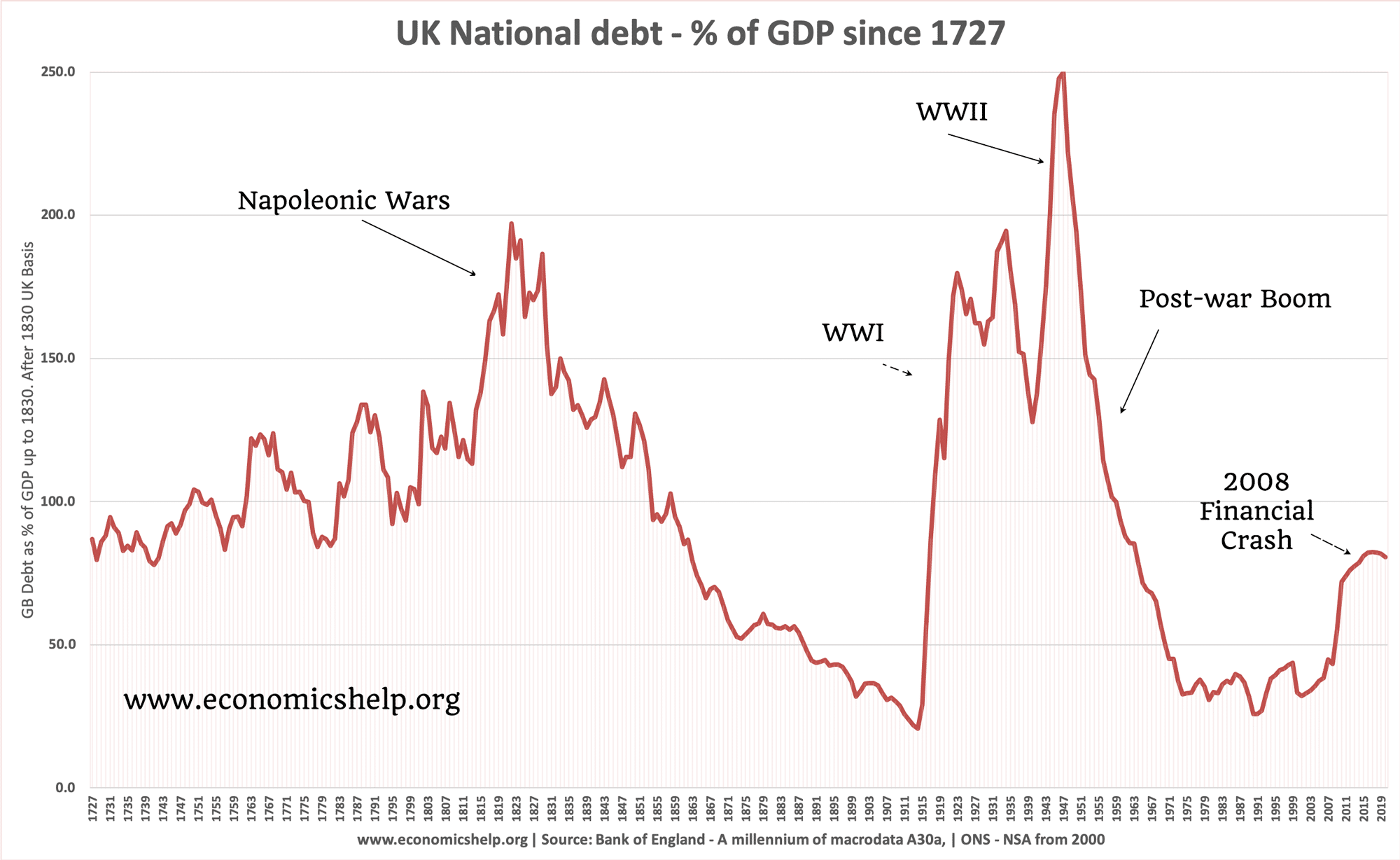
Also, the UK’s debt to GDP ratio is still well below its historical peaks. It was in excess of 200% after the Napoleonic wars and second world war, whereas today it is a touch over 100%.
It is true that consumer and business debt are much higher than in previous generations, but the UK has not defaulted on its bonds since the time of Charles II. Add to this a strong legal system to re-assure investors of legal recourse if the UK did default.
More broadly, inflation could well remain low in a post-pandemic world, resulting in low interest rates for many years. Why not binge borrow, if it doesn’t cost anything in real terms and you can repay over a long period – or even pay back less than borrowed in real terms if inflation increases during the period of repayment?
Some governments are seeing this as a rare opportunity to revitalise their infrastructure. The UK government is ideally positioned to exploit this situation, since the average duration for its bonds to be repaid to investors is long.
At the end of the day, institutions have to keep their money somewhere safe. They would ideally also like a healthy return, but safety may be more important than returns following the global financial crisis and pandemic. If so, government bonds are their best choice and UK bonds are among the best available. Demand for UK government bonds may therefore go up, further decreasing the cost of borrowing.
Moody’s analysis would have made sense prior to the 2008 financial crisis. It does not make sense in today’s world, with historically low-interest rates, long average bond durations and public debt still manageable. In short, the downgrade will not have any impact on the UK’s ability to borrow. The agency has not considered the current context or the broader historical picture, and its assessments are not as relevant as they once were.