

Our planet’s future hangs in the balance due to the unabated greenhouse gas emissions from burning fossil fuels. Treating these emissions as something that can be owned and exchanged in a market has been touted as a solution since the early 1990s, when UN negotiations to agree a limit to global heating began. At the latest round of talks in Azerbaijan, countries finally agreed rules for a global carbon credit market.
I study the world’s current largest scheme: the European Union’s Emissions Trading System (ETS). The ETS, like any other market, is plagued by price speculation and fraud. If this template is replicated on a global scale it will simply waste precious time that could be used to arrest and reverse greenhouse emissions.
The EU ETS is not the same as the UN carbon credit market. We still do not know what mechanisms the latter will use to generate a price on carbon. However, as both have their origins in the Kyoto protocol of 1997, the first global agreement to limit climate change which was replaced by the Paris accords in 2021, we can expect the UN carbon credit market to at least resemble the EU ETS.
That is, a cap-and-trade market in which regulators cap overall emissions and allow polluters to own and trade the greenhouse gases that exceed this limit. The UN carbon credit market will probably have a different cap for each member country. It is likely to depend on national emission reduction pledges.
Allowing market participants to put a price on emissions this way can incentivise more efficient power plants, for example. Those who can make such changes to cut their emissions below the cap can sell their surplus credit to those who cannot. The regulator gradually lowers the cap and the financial incentive is expected to rein in emissions and their harmful effects.
What the ETS can teach the world
The EU ETS, like many of its counterparts, is designed like a financial market. You do not need to manage a factory to be in the EU ETS, being a hedge fund manager or on the carbon trading desk of an investment bank will do. An effective response to climate change must consider the effects of these players on the market price of carbon overall.
Participation by these financial speculators is rife in the EU ETS, and estimated to make up most of the market’s multi-billion dollar trading activity. One finance industry insider described the EU ETS as a place for “wonderful (price) volatility”, led by speculators who buy and sell carbon credits in anticipation of their price changing.
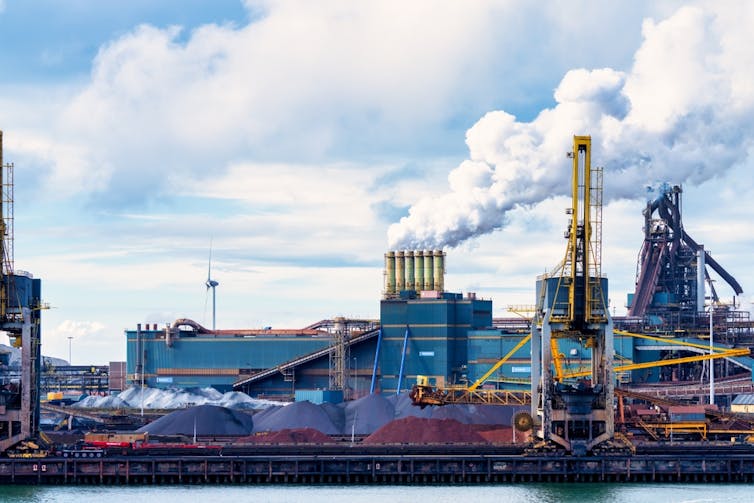
Industrial operators have managed to game the EU’s carbon market. BZ Travel/Shutterstock
Volatility in a global market would hurt developing countries the most, who otherwise stand to be this market’s principle beneficiaries. For example, selling carbon credits could finance the protection of relatively unexploited land and forests, or renewable energy projects that not only cut emissions but also guarantee energy and dignity to the most vulnerable. Carbon price crashes could fatally undermine the financing of such projects.
Speculators commonly do two things: guess what the price of carbon will be by analysing past prices (akin to astrology according to some economists) and make up and act on stories of the near future that will have some bearing on the carbon price.
It is not just financial speculators who can induce price volatility. Dishonest market participants benefit from regulatory loopholes and cause price crashes too. One loophole concerned the EU’s willingness to accept carbon credits under the Kyoto protocol that were derived from single emission reduction projects anywhere in the world.
This encouraged some industrial participants to needlessly emit greenhouse gases which are cheaper to eliminate, like HCFC-22/-23, and turn their subsequent emission reductions into credits which are measured in equivalent C0₂, a much more expensive gas to eliminate.
This was a clear case of carry trade (buy low, sell high), a staple of financial markets that forced down the price of carbon in the EU ETS and undermined the idea of capping and trading away carbon that is supposed to become more and more expensive to emit. Kudos to the EU for closing these regulatory loopholes, albeit with a delay of almost ten years.
Even when functional, existing cap-and-trade markets have a dubious record of cutting emissions. The ETS was revealed to have contributed to less than 2% of annual emission reductions in the EU in a 2021 study.
Yet, the EU has also been a global champion of cutting emissions since the start of the UN climate negotiations. This shows that taxes and green policies, such as renewable energy subsidies and sustainable investment funds, which the EU has, work.
We will have to wait and see how a global carbon credit market for countries and companies alike deals with the issues that the EU ETS has experienced.
The closer this new global carbon credit market resembles such a market, with its speculator storytellers and astrologers, the bigger the price chaos – and the more fraught a global green transition will be.


